Showing posts with label Spriggina. Show all posts

Friday, 5 November 2010

First Thoughts on First Life

Sir David Attenborough's newest documentary, First Life, has just aired on BBC2 and naturally I watched it excitedly. I've not seen the Ediacaran fossils covered properly in a documentary, even though Attenborough has looked at some of them before. The last time I saw them getting a good mention was when the delectable Liz Bonnin looked at them in Bang Goes the Theory, but that did not give them much coverage. The latest series of Sir David made them the main focus, touted as the first examples of complex life and of our own animal kingdom. There is another episode to come next week and accompanying the series is a book which I intend to read and review at some point. Until then I shall provide a very brief review of the episode I just watched.
Sir David Attenborough and Charnia masoni. 

When watching documentaries about a subject I am fond of I have a bad habit of trying to predict what they are about to say, so when I come away having learnt a few things I love it. This is often true of Attenborough documentaries, which he narrates over stunning visuals which keep us gripped. I am pleased to say that I learnt a few things. I have not yet got to grips with how the Ediacaran forms relate to each other temporally, which this documentary did well, introducing the fractal and frondose forms first, ghost-like in appearance and living in the deep sea (they say quite confidently what colour they might have been, which bugged me a little). I didn't even know just how big Charnia could grow, as I was more familiar with the classic Charnwood forest example. It was also mentioned that the fractal form of Fractofusus used only 6 to 8 genetic commands, something I would love to know more about.
Fractofusus from Mistaken Point.
They then moved forward in time, showing the shallow water icons of Ediacara such as Spriggina, Dickinsonia and Kimberella. This is where I started to disagree with them a little. They showed a beautiful Dickinsonia which appears to be at the end of a trail (making it a mortichinia trace) showing that it was mobile, though likely very slow. This is another thing I know little about, so I can't comment right now. Whenever Spriggina was mentioned I was not as impressed, for they kept referring to it as bilateral even though it shows glide symmetry, in which each side is slightly offset and not an exact mirror image. The animations showed it as some sort of proto-arthropod confidently moving around, which is hardly surprising with Jim Gehling as an advisor. I'm not completely against this interpretation as it is a simple shoehorn, but it is not without its difficulties. Kimberella on the other hand is one I don't mind being shoehorned, as its morphology and likely radula marks do make it seem very molluscan.

Before the documentary was shown in full I watched a few clips on Youtube, one of which intrigued me rather a lot and made me quite sceptical. Mary Droser was shown discussing Funisia, a fossil which she claims as the first providing evidence of sexual reproduction. The clip showed that the evidence for this were clusters of traces which varied little in size, showing that they were of the same age. At first I couldn't figure out why this would indicate sexual reproduction, so it was fortunate that the documentary showed why. Corals reproduce in the same way, occasionally asexually, but then sometimes sending out large amounts of sperm and eggs to found new colonies, all of which would be the same age, just like the Funisia found. See here for a little more.
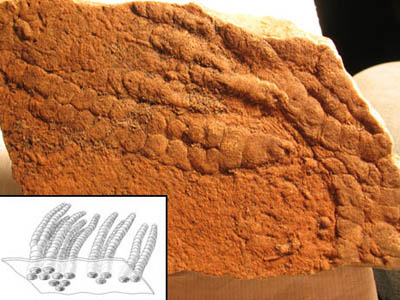
Funisia fossils and a reconstruction.

The next really fascinating bit showed the research of Phil Donoghue from the University of Bristol, using an enormous synchrotron to look at fossil embryos. Using the powerful technology he is able to see the developing organism inside the egg sac, even after half a billion years. The reconstructions show that the worm inside had teeth at the front and a gut running right through the middle. This thing was both complex and predatory. Early embryos are yet another area I really need to look into, perhaps I could pester him in Bristol when I go next week.....

Overall the documentary is well worth watching; as ever the visuals are great, the reconstructions are not amazing but are quite fascinating, the insight is excellent and the fossils are beautifully filmed. Although I disagree with some aspects I know that is inevitable when it comes to Ediacarans and I learnt a lot from this, giving me new areas to research. If you missed it, then BBC iPlayer is your new best friend.

Wednesday, 5 May 2010

Today's Critter: Bomakellia

Today I spent most of my time looking at Cretaceous rocks, so it would not be surprising if I said this critter was Cretaceous. It wasn't. Not even close. Bomakellia kelleri is another fascinating fossil of the Ediacaran fauna, dated to 555 million years old. It is known only from this 9cm long specimen:
It was originally classified as a potential arthropod, possibly even a primitive trilobite or anomalocarid. If it had arthropod affinities then it was certainly primitive. The possible semicircular cephalon and tri-lobed appearance may link it to trilobites, though it does not have segmented limbs or antennae (which may be due to its primitive nature or due to preservation as these parts often do not fossilise in trilobites). Trilobites also have gills on the body, which Bomakellia may be sporting, though this has been a possible connection with the anomalocarids. Below is a reconstruction which fits with the arthropod interpretation:
More recently, as with many of the Ediacaran fauna, it has been interpreted as a possible rangeomorph. The most famous rangeomorph is perhaps Charnia. Rangeomorphs have a frond like structure and were possibly colonial animals, attaching themselves to the sea floor by a hold-fast (interpreted as the head when classed as a proto-arthropod). Spriggina is another Ediacaran organism which has been seen as both a possible arthropod with trilobite affinities and a rangeomorph. Below is Bomakellia reconstructed as a rangeomorph:

Monday, 19 April 2010

Thaumaptilon - Today's Critter

Today I decided to look at an organism called Thaumaptilon (wonderful soft-feather)  as it is believed to be a survivor from the Ediacaran fauna which was found in the Burgess Shale of the mid-Cambrian. This superficially leaf-like animal is considered to be a cnidarian and lived its life attached to the sea floor by a holdfast. It grew to around 8 inches and was covered in spots on one side which may have been zooids, suggesting it was a colonial animal.


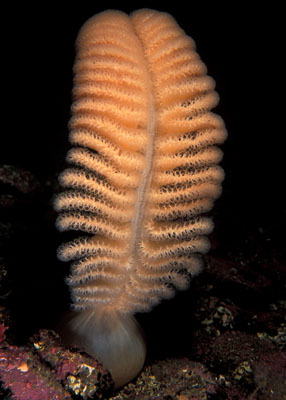
These animals were once thought to be sea pens, like the one in the image on the right, however, this has been strongly questioned on numerous lines of evidence. So why have I chosen something which is similar to a sea pen and didn't really do much? Well, Thaumaptilon was linked to Ediacaran forms such as Charnia which had long been tricky to classify (it still is). If Thaumaptilon was indeed both related to Charnia and to modern pennatulacean cnidarians (sea-pens) then it would be strong case against the concept of the Vendobionta of Adolf Seilacher. Seilacher proposed that the Ediacaran organisms were an evolutionary experiment in multicellularity which left no descendants. He also proposed that these quilted forms, of which Charnia  was one, had a hard outer layer which explained why they fossilised so well. Modern sea-pens do not have this outer layer and so the link would have dealt a heavy blow against it.

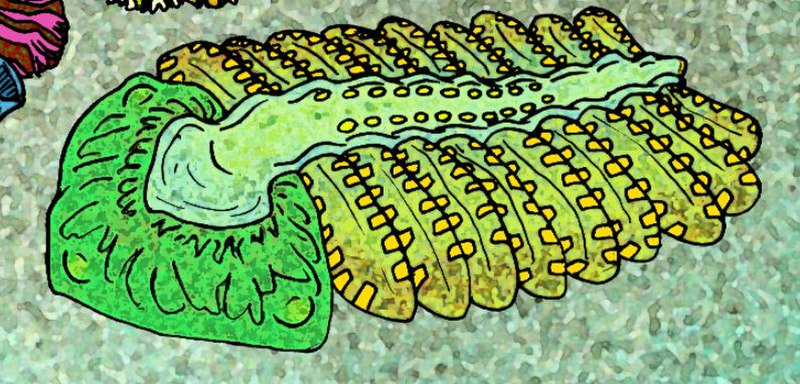
This image shows Thaumaptilon  along with the Ediacaran forms Charnia  and Spriggina. Charnia is named after Charnwood Forest in Leicestershire where it was initially discovered (so I have managed to keep most of the critters British so far). Spriggina is quite fascinating as it has been classified as an annelid worm, a rangeomorph frond, an arthropod (possible trilobite ancestor), and a proarticulate. In this image is another Cambrian form, Stromatoveris, which has been classified as a ctenophore. The image below shows a potential phylogeny on which both Thaumaptilon  and Stromatoveris can be seen.
I wouldn't like to comment on the potential relationship with Charnia  at the moment. Current popular opinion seems to be that we just don't know. The Ediacaran and early Cambrian fauna are some of the most difficult to study enigmatic organisms known to palaeontology. Thaumaptilon may not have been doing much when it was alive, but from a palaeontological perspective it is fascinating.