Thursday, 22 April 2010

Pokémon Palaeontology I


There are a few parallels between pokémon and palaeontology, both have the collecting aspect and both give the desire to discover new species. On top of this there are fossil type pokémon, which I will be looking at here, and also many are based on extinct organisms. I do feel I should point out that the evolution seen in pokémon is nothing of the sort, it is metamorphosis. If the pokémon gave birth to the next "evolution" then it would be an extreme case of saltation (a large leap) similar to the hopeful monster approach of Goldschmidt, which is known not to occur. As it occurs within a single generation and is repeatable by other members of the species, it is definitely metamorphosis.

I always liked pokémon, I played the Gameboy game (I bought red at first) and had a love of fire type pokémon, so naturally I picked charmander. I also collected the trading cards, which I still own. I played gold when it came out, but after that slowed down. I last played diamond, though I lost it for a while and now that I have found it again I have nothing to play it on. I can't buy the new game for the same reason, so I thought that instead I would indulge myself by looking at the various palaeontology influenced pokémon and come up with my own ideal team (in the form of a gym leader with a theme and not simply the sort you would challenge the elite four with).


Kabuto and Kabutops are  favourites of mine. I naturally chose the dome fossil while playing red in order to get these. Kabutops was often a member of my team on the Gameboy game and I often select it when playing Pokémon Stadium too. They are a combination of both rock and water type, making them quite versatile in battle. In contrast with Omanyte and Omastar, they have a more attacking style which they sacrifice some defence for. Kabuto is based on the living horseshoe crab and of course the extinct trilobites. Kabutops is based on the eurypterids, though its cephalon and pleural segments connect it to trilobites and genus Cheirurus  seems to be the preferred comparison.

Next up are Omanyte and Omastar, which are resurrected from the helix fossil within the game. Both are also rock and water type and quite clearly are based on ammonites. 

Also from the original games comes another which I used to use often, the flying and rock type Aerodactyl. Aerodactyl is another obvious one, both the appearance and name suggest that it was based on some sort of pterosaur, often labelled pterodactyls. More specifically it could be a Ramphorynchoid as it had teeth and a tail.


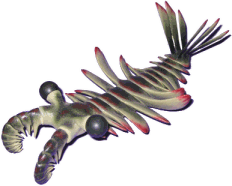
A big jump through the pokédex now to Anorith and Armaldo. These are a mixture of rock and bug type (though oddly not water type considering their basis) and Anorith is resurrected from the claw fossil. Anorith for me is the interesting one as it was based on the Cambrian beasty Anomalocaris for which the tale of discovery is fascinating.  Originally Anomalocaris  was believed to be three different species; the mouth part was thought to be an unusual jellyfish called Peytoria; the front appendages were thought to be the back end of a shrimp; and the body was thought to be a sponge.
Armaldo is rather different as it is a bit of a mish-mash of different prehistoric organisms. It is supposed to be based on Anomalocaris,  but seems to have features thrown in which fit the thyreophorans (the dinosaur group containing stegosaurs and ankylosaurs). Below is a picture of the awesome Anomalocaris  for comparison:


The root fossil brings back Lileep, which evolves into Cradily. Both are rock and grass type, though it is again odd that they are not water type, considering the habitat of what they are based on. Both of course are based on Crinoids, also known as sea lilies. It is a tad annoying that they are plant type, as their superficial resemblance to flowers cause many to think of them as plants, when they are actually animals, more specifically echinoderms. Personally I think Lileep is quite cute, whereas Cradily looks demented.


Shieldon and Bastiodon are next, coming from the armour fossil. Both of these are based on ceratopsian dinosaurs, with Shieldon resembling a Protoceratops to an extent, while Bastiodon is apparently based on Zuniceratops.

These two are both rock and steel type, making their head shields tougher than any ceratopsian ever managed.


Last for now are Cranidos and Rampardos, resurrected from the skull fossil and they are the only fossil pokémon to be only rock type. Both are obviously based on pachycephalosaurs, though apparently Rampardos is more specifically based on pachycephalosaurs such as Dracorex or Stygimoloch. I find the name Stygimoloch amusing as it means "horned devil". 

For now I will leave it there, having covered the specifically fossil type pokémon. There will be more to come though, as many pokémon are based on prehistoric critters and I also intend to list a gym leader type team. I will go easy on the images next time, they have messed with the format too much and the amount of blank space is annoying.

Science Humour

Whilst searching for the images to my last post I stumbled on somebody else's blog from a couple of years ago containing some amusing science-themes images. I thought I would steal a couple of them to post here.

That honestly did make me laugh a fair bit.

Though this one did even more so, it was the "maybe" that did it. There was also this quantum mechanics themed joke, which I rather liked:

Q. Why was Heisenberg no good in bed? A. Because when he had the position he never had the momentum, and when he had the energy he never had the time.

This one is predictably my favourite, and how could I not post a palaeontology themed one? Now, how can I steal this for my palaeodoodles?

And to finish, a good message about science:

Palaeontology in Popular Science

I thought I would recommend a few books which give good insight into the world of palaeontology that are not too technical and are interesting to read.

Neil Shubin's book Your Inner Fish is a fantastic read, the sort where you absorb a lot of information without realising. It is very easy to follow and does not bombard the audience with complicated ideas and jargon. It begins with a palaeontological story, in which Shubin talks about how he learnt the trade and how he used palaeontological principles in order to discover the now famous transitional fossil Tiktaalik roseae,  aka the "fishapod". Shubin aptly demonstrates how this applies to us by crossing disciplines into developmental biology and genetics, something palaeontologists are doing more and more often. Personally for me this book was very useful. I almost didn't buy it but am so glad I did as it helped me make some big decisions. My life was hitting a dead-end and I had become heavily drawn to palaeontology. Reading this book helped confirm that I would like to go into the field of palaeontology during a time when I was having to make the decisions leading to it.


I was going to avoid books about dinosaurs, but I felt that Grave Secrets of Dinosaurs  by Phil Manning was worth mentioning. It presents the more glamorous side of palaeontology, the sort which grips the imagination of the public. It centres around the discovery of a Hadrosaur called Dakota, which is rare in that it has the soft tissues preserved in a 3D structure and can potentially tell us a lot about dinosaurs which we didn't already know. In other areas of palaeontology soft tissue preservation is quite common, but not with dinosaurs. I was going to avoid dinosaur books simply because people mistakenly equate palaeontology to the study of dinosaurs, when really dinosaurology is a small subset which gets a lot of attention. I chose to list this book as it also crosses disciplines, this time into geochemistry, and it also mentions a lot of hi-tech approaches which may contrast with the other books.


If I could only recommend one of these books, it would probably be Trilobite  by Richard Fortey. Not because of a fondness for trilobites (which pretty much emerged due to this book anyway) but because it is both superbly written and highly informative. Fortey applies the study of trilobites to a broad range of areas including evolution, biostratigraphy, continental drift and more. Not only does he demonstrate many different aspects and applications of palaeontology, but he also elucidates the world of trilobites, unveiling numerous wonders. This book has also been a personal help. I was beginning my journey into palaeontology at the time I read it (I am still a long way off of fully achieving it) and it gave me the comfort of feeling that I was on the right track and that this is what I want to do. I could not recommend this book more.


I recommend this book because it gives a good overview of the fossil record, documenting many excellent fossil transitions. It contains many images and is easy to navigate if you ever want to use it for quick reference. The title says it all really, Evolution: What the Fossils Say and Why it Matters. Donald Prothero, the author, does at times get a little repetitive and shrill with his criticisms of creationism. Nearly every fossil example is followed by an example of how creationists distort or ignore the data. I often found myself hoping that he would stop doing that and focus on the fossils, as that is where this book shines. I've not seen any other books for the general public which match this one for its coverage of the fossil record and the study of evolution, so for this I recommend it.


Last but certainly not least is Wonderful Life as no list of books on palaeontology would be complete without the work of Stephen Jay Gould and this book is near enough a masterpiece. Quite a lot about palaeontology is presented in this book, demonstrating the techniques used by palaeontologists and the issues they face when interpreting fossils. Gould also puts them into a wider context in a way few could manage so effectively. He eloquently elucidates the weird wonders of the Burgess Shale Cambrian fauna, though for this it is sadly now out of date in many ways (science does progress, after all). To accompany this book I would recommend The Crucible of Creation  by Simon Conway Morris as it updates some of the findings, expands on some of the themes, and at the same time comes to the opposite conclusion to Gould, making for gripping reading. However, Conway Morris' book is also ageing and gets a bit shrill when criticising Gould, so if you just want to know more about Cambrian fauna, perhaps something more up to date is required.

Microdictyon Again

Yesterday I did not post a new critter and today has been the same, however, I do want to say more about Microdictyon. The small shelly fauna (left) of the early Cambrian are a group of fossils which are isolated hard parts, all small as the name suggests, and all are difficult to classify. Many of them are still mysterious, though occasionally discoveries are made which put some of them into context, often throwing up surprises. Microdictyon  means "little net" and was the name of a phosphatic microfossil in the early Cambrian. The microfossils have a distinct net like structure, hence the name.

It wasn't until fossils in 1989 were found with soft tissue preserved. Nobody could have predicted that it would turn out to be an armoured lobopodian. The sclerites were found to sit just above the lobopods, on each side, looking like shoulder pads. It is likely that they were used for defensive purposes, though it has even been suggested that they were compound eyes like those of trilobites.

Tuesday, 20 April 2010

Words Just Cannot Do Justice To My Incredulity

If you don't know who Kent Hovind is then I suggest you run a mile every time you see his name, he is perhaps the worst creationist apologetics has to offer. However, if you, like me, are building up an immunity to his drivel somehow, then try reading this. It turns out Kent posts imaginary conversations, usually quite self-aggrandising, on a blog site, which he writes whilst in prison. In this example he discusses with Ardi (if you don't know about Ardi then you are on the wrong site here). I don't want to say more, just read it: http://www.cseblogs.com/2010/04/19/knee-mail-“if-ardi-could-talk”/

Monday, 19 April 2010

Thaumaptilon - Today's Critter

Today I decided to look at an organism called Thaumaptilon (wonderful soft-feather)  as it is believed to be a survivor from the Ediacaran fauna which was found in the Burgess Shale of the mid-Cambrian. This superficially leaf-like animal is considered to be a cnidarian and lived its life attached to the sea floor by a holdfast. It grew to around 8 inches and was covered in spots on one side which may have been zooids, suggesting it was a colonial animal.


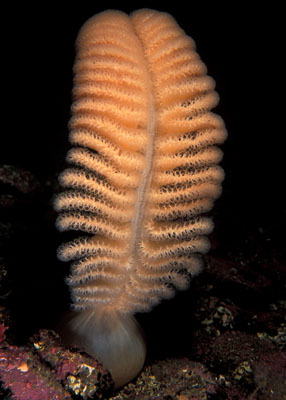
These animals were once thought to be sea pens, like the one in the image on the right, however, this has been strongly questioned on numerous lines of evidence. So why have I chosen something which is similar to a sea pen and didn't really do much? Well, Thaumaptilon was linked to Ediacaran forms such as Charnia which had long been tricky to classify (it still is). If Thaumaptilon was indeed both related to Charnia and to modern pennatulacean cnidarians (sea-pens) then it would be strong case against the concept of the Vendobionta of Adolf Seilacher. Seilacher proposed that the Ediacaran organisms were an evolutionary experiment in multicellularity which left no descendants. He also proposed that these quilted forms, of which Charnia  was one, had a hard outer layer which explained why they fossilised so well. Modern sea-pens do not have this outer layer and so the link would have dealt a heavy blow against it.

This image shows Thaumaptilon  along with the Ediacaran forms Charnia  and Spriggina. Charnia is named after Charnwood Forest in Leicestershire where it was initially discovered (so I have managed to keep most of the critters British so far). Spriggina is quite fascinating as it has been classified as an annelid worm, a rangeomorph frond, an arthropod (possible trilobite ancestor), and a proarticulate. In this image is another Cambrian form, Stromatoveris, which has been classified as a ctenophore. The image below shows a potential phylogeny on which both Thaumaptilon  and Stromatoveris can be seen.
I wouldn't like to comment on the potential relationship with Charnia  at the moment. Current popular opinion seems to be that we just don't know. The Ediacaran and early Cambrian fauna are some of the most difficult to study enigmatic organisms known to palaeontology. Thaumaptilon may not have been doing much when it was alive, but from a palaeontological perspective it is fascinating.

Sunday, 18 April 2010

Politics

For the record I am not really interested in politics, though I really should register to vote. Anyway, I have found my ideal party, who I hope I can vote for.


Trilobite Tattoos?

As I have tattoos already, the thought of a trilobite tattoo would be quite tempting. I found this website which shows some trilobite tattoos on others.

I am seriously going to look into this properly now...

Crinoids of the day

For today's critters it seems only fitting that they are crinoids. They have been mentioned a couple of times on this blog, but today brought a surprise with two (and now three) blogs on crinoids. The following is Protaxocrinus from the Ordovician. Protaxocrinus girvanensis can be found in Ayrshire.

The next is Diabolocrinus,  also Ordovician in age and found in Ayrshire.

A Crinoid Coincidence

Earlier today I posted about the crinoid poster I did for a uni project. Coincidentally I have just found an article on Science Daily which is not simply about crinoids, but about their evolution in response to predation. This information would have been useful for the poster as it was about the adaptive evolution of Palaeozoic and Mesozoic crinoids. The article in question is about the evolution of motility in Mesozoic crinoids in response to predation by sea urchins.

Evolutionary arms races are often postulated as the cause of rapid evolutionary escalations, however, they are not always easy to demonstrate. In an excellent study of both living examples and fossils, researchers from the University of Michigan have demonstrated that crinoids evolved their defensive strategies in response to being preyed upon by sea urchins (Baumiller led the research, who also led the research in one of the papers we cited in our poster).

Modern crinoids were quite recently found to be able to crawl away from stressful situations and reattach to substrate in a new location. Palaeozoic crinoids were unable to do this and so invested in stronger "armour" in order to provide protection. The researchers placed sea urchins in a tank with both crinoid fragments and living crinoids. They observed the sea urchins feeding on the fragments and the living crinoids. This confirmed that sea urchins do feed on crinoids and also provided the necessary clues for scrutinising the fossil record. The undigested parts bore characteristic teeth marks from the sea urchins.

The palaeontologists then analysed 2,500 stalked crinoids from the Triassic period, looking for the same bite marks and scratches. Over 500 had such markings, suggesting that predation by sea urchins was a strong ecological presence for early Mesozoic crinoids and the likely driver behind the evolution of motility.

The timing of the occurrence also has significance, as most examples of evolutionary arms races comes from the Mesozoic Marine Revolution, which occurred around 75 Ma later. For crinoids it appears that the arms race had long been raging due to the evolution of stronger, more active feeding apparatus in echinoids.

The journal article can be found here.

Adaptive Crinoids: Palaeontological Poster Presentations


A few months ago we were set the task, in groups, of producing a poster to be presented in front of the rest of the people on our course. At conferences scientists often do poster presentations of their recent work and display them so that other scientists can browse them and easily find out more. Our task was to produce the same sort of thing, albeit it on a smaller scale as there are only 11 of us on our course. The poster I co-produced is titled A Comparison of the Adaptive Strategies of Palaeozoic and Mesozoic Crinoids, however, on the day it tended to be referred to as Adaptive Crinoids. Our poster came joint first, which is why I feel it is worth sharing. As my prize I chose the superb book Wonderful Life  by Stephen Jay Gould. The picture may not be brilliant quality as I currently only have a trial version of powerpoint and so can't edit it to make it suitable. I can't even copy and paste the writing.


So there it is. There are a couple of mistakes, but nothing major. We seemed to get a good balance of information and aesthetic value. The poster should not be so wide, the black edges need trimming back in this image. If it is too hard to read that may be because it was made for A1 sized paper.

Saturday, 17 April 2010

The critter of the 17th of April

In a break from trilobites found in Britain, I think it makes sense to present the organism which is currently my profile picture.


This is Microdictyon, an armoured worm from the early Cambrian. It is often classed as a lobopod, though this phylum is not well defined. It is well known from fossils of its sclerites, with some soft-bodied fossils found in China. It has ten pairs of sclerites on its side, matching its pairs of tentacles, and the anterior and posterior are featureless (this image makes the sclerites look like eyes). There are 11 species of Microdictyon, one of which is amusingly called M. anus. 


I am becoming quite fascinated by early metazoan evolution, right up to the Cambrian explosion. Microdictyon  is one of the small shelly fossils of the post-Tommotian Maotianshan shales. 

Friday, 16 April 2010

Critters of 16/4/10

tesFor today I have gone for more trilobites, both of which are agnostids. Most agnostid trilobites are eyeless and have a similar sized pygidium as the cephalon, making it difficult to determine which end is which sometimes.

This first agnostid trilobite is Lotagnostus which is from the Upper Cambrian. Lotagnostus trisectus can be found near the Malvern Hills. It is sometimes known as Agnostus trisectus. 

This agnostid trilobite is Eodiscus punctatus, from the Middle Cambrian. It can be found in Wales and is sometimes referred to as Microdiscus punctatus. 

Thursday, 15 April 2010

Critters of the *blank*

I am surprised that I did not have this idea sooner as it is the sort of thing found on many blogs. I have decided to update more regularly, though mostly images and not too much writing. I shall be doing the "animal of the week" sort of thing, but a week seems like too long. Daily might get tedious, so the time period is irrelevant (hence the *blank* in the title). Of course, this being the Palaeobabbler it is only fitting that they are extinct critters. I'll probably post a mixture of fossil images and reconstructions, depending on what I find really. Some will follow themes (the first lot will likely be species taken from British Palaeozoic Fossils as I just got it out of the library) and some may be quite random.


This first specimen is Olenelloides, a gorgeous trilobite from the lower Cambrian. Olenelloides armatus can be found in British Cambrian rocks. I will apologise in advance for anyone who happens upon these posts who is not fond of trilobites, I am likely to put up a few pictures of them. Trilobites are incredible fossils and have such diversity that I could keep posting a new interesting one for quite some time.The most striking feature of Olenelloides is clearly the cephalon (the head part at the anterior), which is almost star shaped. I would love to find a fossil of this some day.

Wednesday, 14 April 2010

How Bitter-sweet!

I've not yet seen the film "Expelled" and am not sure if I have any desire to do so. I have seen clips and read some manuscripts, from what I can tell it is just a lot of rehashed arguments in film form. In the film it is claimed that professing creationists and Intelligent Design advocates are often booted out of academic positions.

This, however, is not quite true. There are creationists who have lost academic positions, but for the same reasons that non-creationists also lose academic positions; if you aren't good at your job you lose it. In his blog, PZ Myers points out that Michael Behe, a very prominent ID advocate, is allowed to keep his job in academia.

Is the creationist community as squeaky clean as they should be? If they are horrified by the spurious claims of creationists being expelled  from academia, do they allow evolution acceptance in their own circles? Apparently not! Prominent evangelical theologian Bruce Waltke has been forced to resign from his position at the Reformed Theological Seminary over a video where he stated that evolution was compatible with Christianity and should be embraced.

I read about this on Myers' blog and when he sticks to science his blog is highly recommended. However, his vituperate diatribe against compatibilism seems rather pointless.

The Palaeodoodler

I'm one of those people who often doodles little cartoony pictures, but rarely anything serious. I don't think I could ever be a serious palaeo-artist, however, I have decided to try my hand at some palaeo-themed comic stuff. I got the idea whilst doodling in a lecture and ended up doing a scene involving a crinoid. Sadly I don't have a scanner so I had to take pictures of them with a digital camera, so they are not amazing quality.

This was the doodle that got me started (I simply call it "Crinoid pub crawl"). For the record, crinoids are not flowers but are often mistaken for them. They are echinoderms, but we like to wind up a friend who is besotted with crinoids by calling them flowers. If I have no ideas I am likely to make a crinoid joke. I haven't gone for accuracy in most of the pictures, but I may do so in future. Articulate crinoids can actually move, there are free swimming types, but even the sessile articulate crinoids can crawl slowly along the deep sea floor. This one here, judging by my random choice of other organisms (the ammonite, the wannabe trilobite and the random filter feeder) would make it Palaeozoic and therefore not a member of the Articulata. Out of view at the top was a random Odontogriphus  which would put the scene in the Cambrian and make it incredibly inaccurate.

This is "Ediacaran Guess Who?" and I did actually draw a lot of semi-accurate Ediacaran organisms on the game board. You might be able to see them by zooming in. I've been getting quite interested in early metazoan evolution, so many doodles will likely be set in the late Precambrian and early Cambrian.

Another doodle from a lecture (you can tell as it is on lined paper). Also simply another joke about crinoids being mistaken for flowers.

In case it is not obvious, those are stromatolites. I don't think it is possible to go wrong with stromatolites really. If anyone points out that stromatolites cannot talk then they might get a slap.

I have a few more ideas to come, some of which are not as simple to draw. My main issue at the moment is that I don't have internet access in my house, so if I need to look anything up (particularly Ediacaran and small shellies) then I have to wait. Ah well, enjoy.

Saturday, 10 April 2010

Exploring the Zechstein Sea

I've lived in Conisbrough, a large village on the outskirts of Doncaster, for most of my life. Even so, I knew very little about the geology of the area until recently. As a child I knew that there were no dinosaurs to be found and that impressive fossils like ammonites were to be found at the coast. I also knew that I was in the heart of the South Yorkshire coal fields (Cadeby Colliery used to be in walking distance and Maltby still has a pit) so I could have guessed that Carboniferous rocks were nearby. Apart from that I also knew that there was a working dolomite quarry nearby, but not what age it was.

This Easter I decided to rectify that. Before returning home I had a look at some of the books in the university library, not really expecting to find much but still hopeful. I looked at the few books they had on the geology of South Yorkshire, mostly getting little information. Eventually I stumbled on a battered looking book from the '60s titled Geological Excursions in the Sheffield Region which contained a chapter titled "Conisborough". The spelling mistake irked me a little, but I read on, only to immediately happen upon them stating that fossils were rare in Conisbrough. Unperturbed I read on. Fortunately the book mentioned just one locality in Conisbrough where fossils could be found and I was determined to find it. The map given was poor and the descriptions of the route were heavily outdated, but still I checked it out of the library in hope.

Below is a better map which I found after finding the place for myself:


I set out looking for it with my friend Johnathan, we had plans to walk somewhere else afterwards but first we would look for fossils as it was on the way. The poorer map had us looking around 150 metres away at some bare rocks which matched none of the descriptions and clearly held no fossils. We had almost given in. As I used to go walking around here I knew of a place at the top of the hill which might just have been it, so we decided it was worth looking. When we got there we were not sure and we looked at a lot of the rocks up close but to no avail.

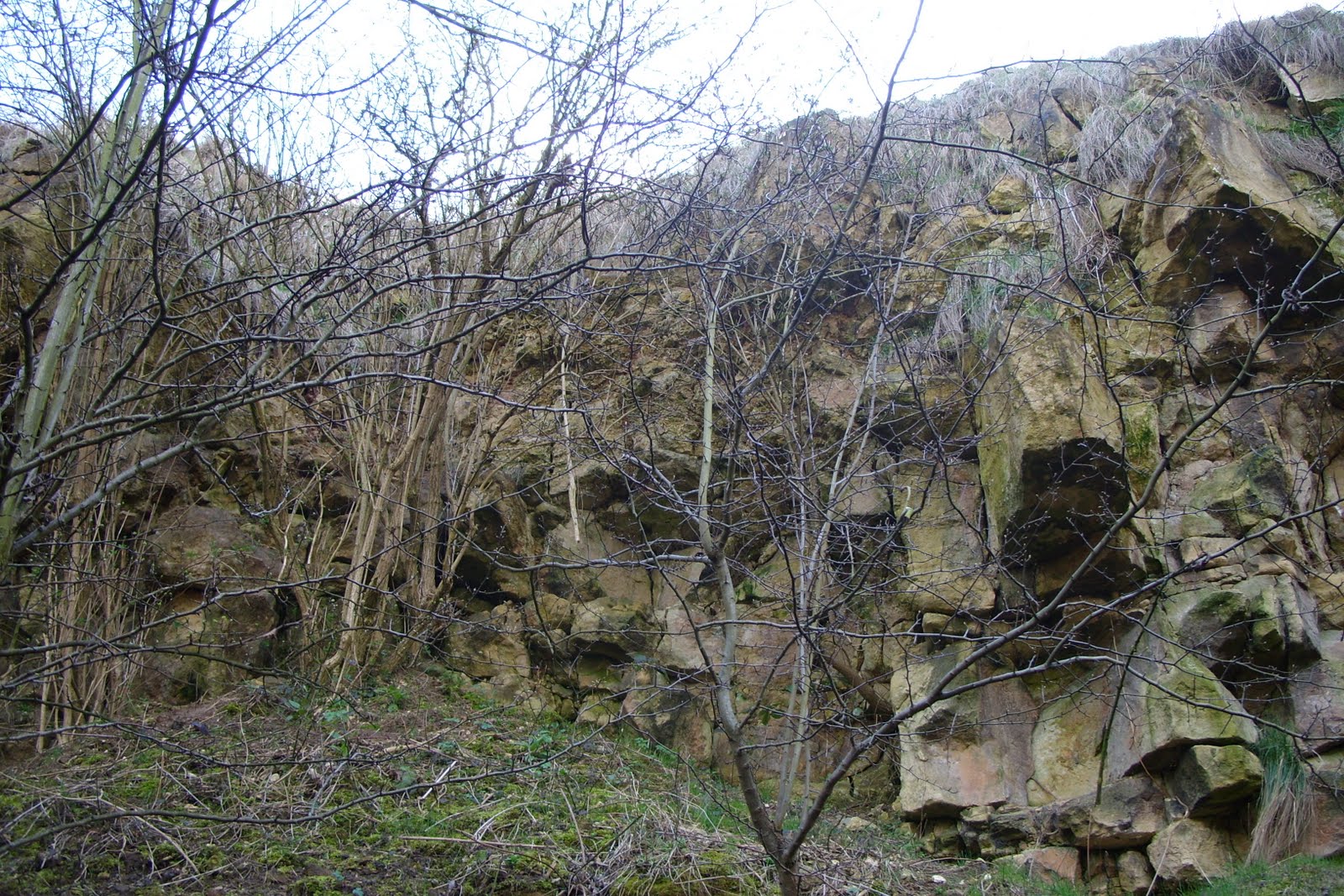
Up close there was a lot of interesting features on the rocks, but not the fossils we were looking for. We may have found shell casts, but with no actual shells we were not convinced. On the left is some of the interesting layering we found, including a lovely brick red colour at the top. It was around this point that Johnathan seemed to have given in. Continuing to look seemed futile and the place was not easy to get around. We were later to realise that this was the old Ashfield Brick-clay Pit, which is now only used by fly-tippers. This was useful for me in my youth as I travelled there in search of things to build dens out of; now it is a bit of a nuisance. Whilst Johnathan wandered off getting bored, I kept looking, having to do a little climbing in the slippery mud. I did find a couple of interesting features:


Above is a picture taken in what could be described as a small cave if I was being generous. What was interesting about it are the mineral precipitations from the ceiling. I can't help but wonder if any of the kids who burn their fires and drink there have ever stopped to admire this. On the right is an example of a quartz vein in the rocks there. They are surprisingly common when you start looking at the rocks, yet I reckon I am one of a handful of people who have stopped to appreciate them.

At this point I was enjoying looking at the rocks and the surprises they held. When I reached the place in the picture on the left I decided to have a look at some of the higher rocks and found myself climbing a very wobbly tree. I found some interesting clays and more quartz veins whilst I sifted through little rocks I found, hoping to find a fossil. Somehow I did it. I picked up a small rock and realised that I was probably holding an ancient shell. I shouted to Johnathan that I thought I had found something, but I really wasn't sure as I had a niggling feeling that I was seeing what I wanted to see.
It was then that I found another, which I sadly do not have a picture of as I gave it to Johnathan as a souvenir of our little expedition. I felt almost triumphant, I had succeeded. In my hands I held two little pieces of ancient history, long dead bivalve molluscs that have been fortunate to fossilise and survive hundreds of millions of years. I've had this feeling before as these were not my first fossil finds, but this meant more to me. Conisbrough will always feel like home to me and now I have a piece of its ancient history. Our fossil hunting was over for the day, so we continued on our walk with some sense of achievement.

My automatic reaction to this is to do some more research. I classified both of these specimens as belonging to genus Liebea but I may be wrong. It certainly does occur around here, but so does Bakevellia and to be honest I can't tell which is which in some examples. I am certain some of my later finds are Liebea, however, it was those that made me think the first specimen might not be. During my research I found this paper which I wish I had in the first place. It has a more detailed description of the rock exposure, is more up to date, and has a map which would have led me to instantly recognise the place.

A few days later I was playing guitar in church on Easter Sunday when I spotted Andrew, a friend I hadn't seen for a long time. After church we went over to the church hall for a cup of tea and a bit of a catch up. I can't remember how we got onto the subject of fossils, but when I said I had found some in Conisbrough his eyes lit up and his mouth dropped. Fossil hunting had become a hobby for him recently and he was even doing a project on them (he is an artist). I think he felt as I did, the thought of finding fossils in Conisbrough, the place of our youth, was exhilarating. It didn't take long before we were both thinking of heading there straight away, I feel like we read each others' minds. So off we set, myself with a guitar on my back, off to the Ashfield pit in search of ancient life.

When we got to the place I had found fossils Andi was using his keen observational skills. He suggested we looked in the area where the rocks had fallen for fossils which had come away from the rock face. I can't believe I had not done this myself, but then I am used to being told to look right up at a rock in order to identify sedimentary structures. As soon as he had suggested surveying the floor I spotted one, a lovely Liebea specimen. I showed Andi so that he knew what to look for and he went on to find four fossils of his own. I went up to my spot up the tree and came across my first brachiopod find, identified as Dielasma, along with a bivalve mollusc which has me baffled at the moment, as it does not fit with anything listed in the paper. Below are my finds up to that point. On the left is my first specimen. The other three are what I found with Andi. They are Liebea (the one which makes me want to reassess the first), Dielasma, and the unidentified bivalve.
After this I did more research. I already knew that I was looking at Permian rocks, so this put the fossils at around 250,000,000 years old. During the late Permian the Earth looked like this, as seen on the picture to the right. Conisbrough sits in an area which used to be the Zechstein sea, an area which stretches to Poland. The Zechstein sea was shallow and land-locked, containing many reef systems, particularly bryozoan reefs in this area it seems.

Predictably I decided I would go back at least one more time before heading to Portsmouth again. This time I went more prepared as I had a bag for specimens, a notepad and pen, and a camera to take pictures of the location. Partly simply to have documented it, partly in case others would like to explore the ancient history of Conisbrough.


This time I barely had to put in any effort. Spotting the fossils became so easy. I brought home around 20 this time and left a few there, keeping only my first finds and the most interesting ones. 
I'd love to spend ages putting up pictures of all of these, but I won't. On the left is a bit of substrate which I have kept in its original condition as it contains the mould of a Liebea specimen, along with two other shells, one of which is definitely a bivalve, but the other I cannot see enough of. After this are the bivalve specimens, one of which has what appears to be the original colouration. Over on the right are the brachiopods I collected, including the smallest which is a tiny 4mm in length. 

After I had found all of these I went to look at more of the rocks. I found no fossils but the rocks were interesting to look at. I also found a spot where an owl or another bird of prey might rest to eat occasionally, as I found numerous small bones. Judging by the jaw bones it was a rodent. Sadly the batteries in the camera died as I tried to take pictures of it, so I packed up and came home.

When I got home I documented them and eventually put them in a safe place (a biscuit tin). Over summer I will be returning to the place as there are species listed in the papers I have looked at which I have not found. For now I will have to wait though as I return to university in just two days.