I've lived in Conisbrough, a large village on the outskirts of Doncaster, for most of my life. Even so, I knew very little about the geology of the area until recently. As a child I knew that there were no dinosaurs to be found and that impressive fossils like ammonites were to be found at the coast. I also knew that I was in the heart of the South Yorkshire coal fields (Cadeby Colliery used to be in walking distance and Maltby still has a pit) so I could have guessed that Carboniferous rocks were nearby. Apart from that I also knew that there was a working dolomite quarry nearby, but not what age it was.
This Easter I decided to rectify that. Before returning home I had a look at some of the books in the university library, not really expecting to find much but still hopeful. I looked at the few books they had on the geology of South Yorkshire, mostly getting little information. Eventually I stumbled on a battered looking book from the '60s titled Geological Excursions in the Sheffield Region which contained a chapter titled "Conisborough". The spelling mistake irked me a little, but I read on, only to immediately happen upon them stating that fossils were rare in Conisbrough. Unperturbed I read on. Fortunately the book mentioned just one locality in Conisbrough where fossils could be found and I was determined to find it. The map given was poor and the descriptions of the route were heavily outdated, but still I checked it out of the library in hope.

I set out looking for it with my friend Johnathan, we had plans to walk somewhere else afterwards but first we would look for fossils as it was on the way. The poorer map had us looking around 150 metres away at some bare rocks which matched none of the descriptions and clearly held no fossils. We had almost given in. As I used to go walking around here I knew of a place at the top of the hill which might just have been it, so we decided it was worth looking. When we got there we were not sure and we looked at a lot of the rocks up close but to no avail.

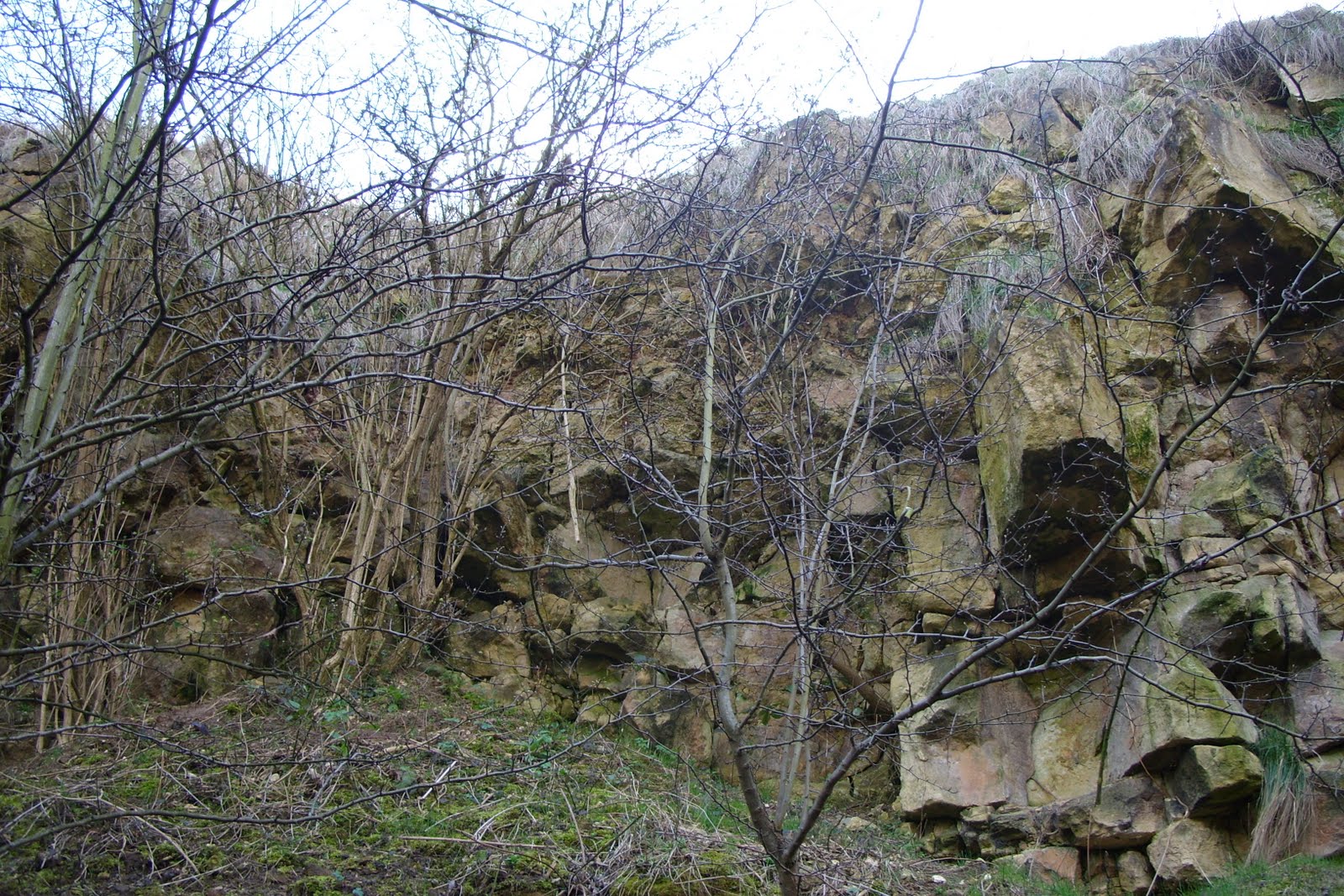
Up close there was a lot of interesting features on the rocks, but not the fossils we were looking for. We may have found shell casts, but with no actual shells we were not convinced. On the left is some of the interesting layering we found, including a lovely brick red colour at the top. It was around this point that Johnathan seemed to have given in. Continuing to look seemed futile and the place was not easy to get around. We were later to realise that this was the old Ashfield Brick-clay Pit, which is now only used by fly-tippers. This was useful for me in my youth as I travelled there in search of things to build dens out of; now it is a bit of a nuisance. Whilst Johnathan wandered off getting bored, I kept looking, having to do a little climbing in the slippery mud. I did find a couple of interesting features:


Above is a picture taken in what could be described as a small cave if I was being generous. What was interesting about it are the mineral precipitations from the ceiling. I can't help but wonder if any of the kids who burn their fires and drink there have ever stopped to admire this. On the right is an example of a quartz vein in the rocks there. They are surprisingly common when you start looking at the rocks, yet I reckon I am one of a handful of people who have stopped to appreciate them.

At this point I was enjoying looking at the rocks and the surprises they held. When I reached the place in the picture on the left I decided to have a look at some of the higher rocks and found myself climbing a very wobbly tree. I found some interesting clays and more quartz veins whilst I sifted through little rocks I found, hoping to find a fossil. Somehow I did it. I picked up a small rock and realised that I was probably holding an ancient shell. I shouted to Johnathan that I thought I had found something, but I really wasn't sure as I had a niggling feeling that I was seeing what I wanted to see.
It was then that I found another, which I sadly do not have a picture of as I gave it to Johnathan as a souvenir of our little
expedition. I felt almost triumphant, I had succeeded. In my hands I held two little pieces of ancient history, long dead bivalve molluscs that have been fortunate to fossilise and survive hundreds of millions of years. I've had this feeling before as these were not my first fossil finds, but this meant more to me. Conisbrough will always feel like home to me and now I have a piece of its ancient history. Our fossil hunting was over for the day, so we continued on our walk with some sense of achievement.
My automatic reaction to this is to do some more research. I classified both of these specimens as belonging to genus
Liebea but I may be wrong. It certainly does occur around here, but so does
Bakevellia and to be honest I can't tell which is which in some examples. I am certain some of my later finds are
Liebea, however, it was those that made me think the first specimen might not be. During my research I found this
paper which I wish I had in the first place. It has a more detailed description of the rock exposure, is more up to date, and has a map which would have led me to instantly recognise the place.
A few days later I was playing guitar in church on Easter Sunday when I spotted Andrew, a friend I hadn't seen for a long time. After church we went over to the church hall for a cup of tea and a bit of a catch up. I can't remember how we got onto the subject of fossils, but when I said I had found some in Conisbrough his eyes lit up and his mouth dropped. Fossil hunting had become a hobby for him recently and he was even doing a project on them (he is an artist). I think he felt as I did, the thought of finding fossils in Conisbrough, the place of our youth, was exhilarating. It didn't take long before we were both thinking of heading there straight away, I feel like we read each others' minds. So off we set, myself with a guitar on my back, off to the Ashfield pit in search of ancient life.
When we got to the place I had found fossils Andi was using his keen observational skills. He suggested we looked in the area where the rocks had fallen for fossils which had come away from the rock face. I can't believe I had not done this myself, but then I am used to being told to look right up at a rock in order to identify sedimentary structures. As soon as he had suggested surveying the floor I spotted one, a lovely
Liebea specimen. I showed Andi so that he knew what to look for and he went on to find four fossils of his own. I went up to my spot up the tree and came across my first brachiopod find, identified as
Dielasma, along with a bivalve mollusc which has me baffled at the moment, as it does not fit with anything listed in the paper. Below are my finds up to that point. On the left is my first specimen. The other three are what I found with Andi. They are
Liebea (the one which makes me want to reassess the first),
Dielasma, and the unidentified bivalve.
After this I did more research. I already knew that I was looking at Permian rocks, so this put the fossils at around 250,000,000 years old. During the late Permian the Earth looked like this, as seen on the picture to the right. Conisbrough sits in an area which used to be the Zechstein sea, an area which stretches to Poland. The Zechstein sea was shallow and land-locked, containing many reef systems, particularly bryozoan reefs in this area it seems.
Predictably I decided I would go back at least one more time before heading to Portsmouth again. This time I went more prepared as I had a bag for specimens, a notepad and pen, and a camera to take pictures of the location. Partly simply to have documented it, partly in case others would like to explore the ancient history of Conisbrough.
This time I barely had to put in any effort. Spotting the fossils became so easy. I brought home around 20 this time and left a few there, keeping only my first finds and the most interesting ones.
I'd love to spend ages putting up pictures of all of these, but I won't. On the left is a bit of substrate which I have kept in its original condition as it contains the mould of a Liebea specimen, along with two other shells, one of which is definitely a bivalve, but the other I cannot see enough of. After this are the bivalve specimens, one of which has what appears to be the original colouration. Over on the right are the brachiopods I collected, including the smallest which is a tiny 4mm in length.
After I had found all of these I went to look at more of the rocks. I found no fossils but the rocks were interesting to look at. I also found a spot where an owl or another bird of prey might rest to eat occasionally, as I found numerous small bones. Judging by the jaw bones it was a rodent. Sadly the batteries in the camera died as I tried to take pictures of it, so I packed up and came home.
When I got home I documented them and eventually put them in a safe place (a biscuit tin). Over summer I will be returning to the place as there are species listed in the papers I have looked at which I have not found. For now I will have to wait though as I return to university in just two days.