Showing posts with label ediacaran. Show all posts

Monday, 24 January 2011

Dickinsonia, still alive?

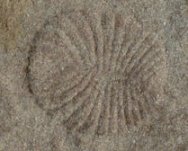
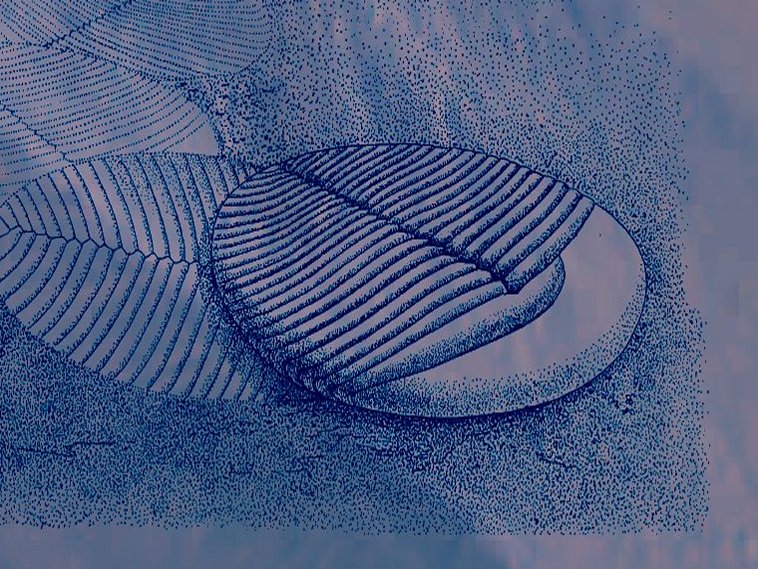
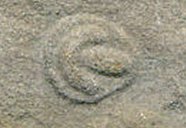
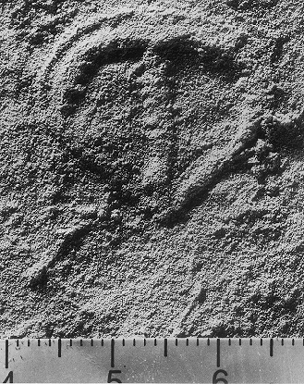
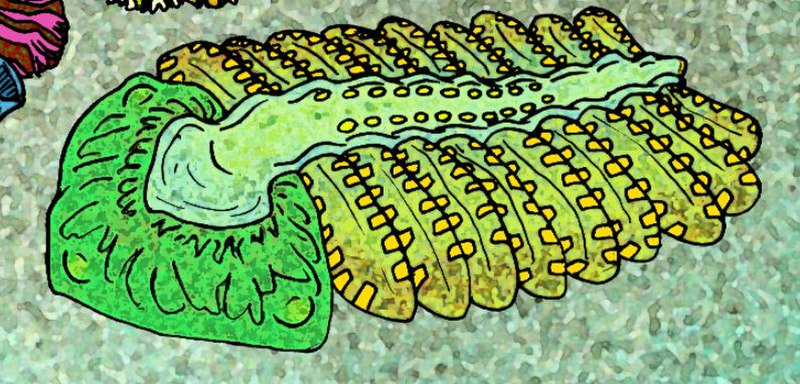
Look, photographic evidence of the Ediacaran form Dickinsonia on the modern sea floor, taken using specialist cameras:


OK, so I lied... this is actually a picture of a Dickinsonia cast which I played around with for a bit. The photo was poor quality so I tried to improve it and ended up finding different settings which made it look like a possible modern photo. A much better job could be done in faking this (not that I am advocating that) as this was a mess around for a few minutes.

Though imagine the implications of finding this thing alive, having been absent from the fossil record for over 540 million years. So many questions would be answered by simply observing it. Does it move? This is constantly being debated as the trace fossils found accompanying some dickinsoniid fossils may not be trace fossils at all. Interpretations range from it being highly mobile, to it moving rarely, to not moving at all but producing the traces through being buffeted by currents. How does it feed? We'd be able to tell whether it sucked up nutrients from algal mats or whether it carried endosymbiotic organisms, or whether it used some completely different mode of feeding. A proper analysis of its morphology would be possible, giving much better insight into its habits, but most importantly its taxonomy. And of course, genetic testing would be possible, answering some of the fundamental questions which might potentially never be answered using fossil evidence alone. Ah, one can dream...

Friday, 5 November 2010

First Thoughts on First Life

Sir David Attenborough's newest documentary, First Life, has just aired on BBC2 and naturally I watched it excitedly. I've not seen the Ediacaran fossils covered properly in a documentary, even though Attenborough has looked at some of them before. The last time I saw them getting a good mention was when the delectable Liz Bonnin looked at them in Bang Goes the Theory, but that did not give them much coverage. The latest series of Sir David made them the main focus, touted as the first examples of complex life and of our own animal kingdom. There is another episode to come next week and accompanying the series is a book which I intend to read and review at some point. Until then I shall provide a very brief review of the episode I just watched.
Sir David Attenborough and Charnia masoni. 

When watching documentaries about a subject I am fond of I have a bad habit of trying to predict what they are about to say, so when I come away having learnt a few things I love it. This is often true of Attenborough documentaries, which he narrates over stunning visuals which keep us gripped. I am pleased to say that I learnt a few things. I have not yet got to grips with how the Ediacaran forms relate to each other temporally, which this documentary did well, introducing the fractal and frondose forms first, ghost-like in appearance and living in the deep sea (they say quite confidently what colour they might have been, which bugged me a little). I didn't even know just how big Charnia could grow, as I was more familiar with the classic Charnwood forest example. It was also mentioned that the fractal form of Fractofusus used only 6 to 8 genetic commands, something I would love to know more about.
Fractofusus from Mistaken Point.
They then moved forward in time, showing the shallow water icons of Ediacara such as Spriggina, Dickinsonia and Kimberella. This is where I started to disagree with them a little. They showed a beautiful Dickinsonia which appears to be at the end of a trail (making it a mortichinia trace) showing that it was mobile, though likely very slow. This is another thing I know little about, so I can't comment right now. Whenever Spriggina was mentioned I was not as impressed, for they kept referring to it as bilateral even though it shows glide symmetry, in which each side is slightly offset and not an exact mirror image. The animations showed it as some sort of proto-arthropod confidently moving around, which is hardly surprising with Jim Gehling as an advisor. I'm not completely against this interpretation as it is a simple shoehorn, but it is not without its difficulties. Kimberella on the other hand is one I don't mind being shoehorned, as its morphology and likely radula marks do make it seem very molluscan.

Before the documentary was shown in full I watched a few clips on Youtube, one of which intrigued me rather a lot and made me quite sceptical. Mary Droser was shown discussing Funisia, a fossil which she claims as the first providing evidence of sexual reproduction. The clip showed that the evidence for this were clusters of traces which varied little in size, showing that they were of the same age. At first I couldn't figure out why this would indicate sexual reproduction, so it was fortunate that the documentary showed why. Corals reproduce in the same way, occasionally asexually, but then sometimes sending out large amounts of sperm and eggs to found new colonies, all of which would be the same age, just like the Funisia found. See here for a little more.
Funisia fossils and a reconstruction.

The next really fascinating bit showed the research of Phil Donoghue from the University of Bristol, using an enormous synchrotron to look at fossil embryos. Using the powerful technology he is able to see the developing organism inside the egg sac, even after half a billion years. The reconstructions show that the worm inside had teeth at the front and a gut running right through the middle. This thing was both complex and predatory. Early embryos are yet another area I really need to look into, perhaps I could pester him in Bristol when I go next week.....

Overall the documentary is well worth watching; as ever the visuals are great, the reconstructions are not amazing but are quite fascinating, the insight is excellent and the fossils are beautifully filmed. Although I disagree with some aspects I know that is inevitable when it comes to Ediacarans and I learnt a lot from this, giving me new areas to research. If you missed it, then BBC iPlayer is your new best friend.

Saturday, 31 July 2010

Sean Carroll and Ediacaran Reductionism

It is no secret that I am a fan of Sean B. Carroll, a prominent geneticist who often gets to voice his opinions on evolutionary theory. I mentioned him in a previous blog which was about the genetic changes involved in form and function, wherein Carroll's prediction was validated by the study. He is one of the main scientists at the forefront of evo-devo, investigating through genetics and embryology the relationship between genotype and phenotype. He often discusses the role of gene switches in the evolution of phenotypic change. His first book, Endless Forms Most Beautiful, looked at how gene expression produces form such as patterns and limbs and is one which I fully recommend to anyone wanting to get insight into this field. His second book, The Making of the Fittest, looks into the genetic evidence for evolution and also comes recommended, being better written than his first and containing some very interesting examples. I have not yet read his third book, so I can't comment on that one.

Recently, in the New York Times, Carroll published an article titled Translating Stories of Life Forms Etched in Stone  about the impact of the Ediacaran fossils. He chronicles the thought surrounding these fossils, starting with Darwin's dilemma of a lack of fossils before the Cambrian, through the discovery of the first Ediacaran fossils to modern views surrounding the fossils. There's some interesting information in the article, I particularly like the mention that Andrew Knoll likens the Ediacarans to a Rorschach test, as everyone interprets them differently. Reading through the article though and it seems Sean Carroll, who is not a palaeontologist (so I wonder why he wrote this article), favours the shoehorning interpretations of Gehling. The first clue can be seen in the image which accompanies the article:

This is a Pteridinium from Namibia, which looks bilateral in this image even though other fossils show that it is not and actually has a three lobed body. For example:
This choice of image puts the idea of bilateral forms in mind, the fossil doesn't actually look too unusual compared to some Ediacarans. Accompanying the article online is a slideshow with some incredible photos. The first is a small and beautiful Dickinsonia from the Ediacara Hills, chosen because it is mentioned in the article and maybe also because it looks superficially like many extant forms. Also from Australia is Spriggina, another which is iconic of the Ediacaran forms and is often thought to be related to modern forms (despite the difference in symmetry). Next is Archaeaspinus from the White Sea in Russia, a form which is often labelled as from the group proarticulata, a proposed phylum which also includes the two previous organisms. These are often linked with the chordates, an interpretation which would likely please Carroll.

Next in line on the slideshow is  Fractofusus from Mistaken Point in Newfoundland, a spindle-like fossil which would be difficult to shoehorn into modern groups. Kimberella comes next and was mentioned in the article, this one is from Russia. This fossil has often been considered to be a possible mollusc and potential radula marks have been found around the fossils. Following Kimberella is Charniodiscus, this one from Newfoundland and curiously the image is upside down. Charniodiscus is an interesting frond fossil which is sometimes linked to the sea pens. A favourite of mine follows, Parvancorina,  from Australia, a shield like fossil which can be tentatively linked to the trilobites. The final image is Yorgia from Russia and is often linked to the proarticulata. Anyway, back to the article.

The first hint of Sean Carroll's chosen interpretation comes subtly in the following sentence:

Dickinsonia, for example, has been interpreted as being a relative of jellyfish, a marine worm, a lichen, or even as a member of a completely extinct kingdom.

The concept of the Vendobionts is not an unpopular one as this phrasing might suggest. Carroll makes it sound like an extreme view. His view becomes more obvious soon enough, as he says, "But, in fact, such simple bodies are exactly what should be expected of primitive forerunners of later animals." He says this in relation to the lack of features which we use to identify extant phyla today and in that I agree with him, however, he must also ignore the features found in some Ediacaran forms which exclude them from known phyla. He also states that a few bilateral forms are known and gives Kimberella as an example, but it is not clear whether or not he takes into account that many display glide symmetry and not typical bilateral symmetry; Kimberella is one of the few which seems to actually be bilateral. 

Carroll then goes on to explain why these multicellular forms took so long to appear and does a good job, but then ends by saying, "Our earliest animal ancestor probably had no head, tail, or sexual organs, and lay immobile on the sea floor like a door mat." 

Overall the article is a good read and quite informative. It is odd that it is written by a geneticist and not a palaeontologist, but Carroll does not get things wrong, he simply puts his own slant on things, a slant which is shared by many palaeontologists. It would be interesting to see what a palaeontologist like Seilacher would think of the article. 


Sunday, 25 July 2010

Dickinsonia and Spinther: A Frustrating Comparison

The Ediacaran genus Dickinsonia is an iconic form which still eludes identification. In its time it has been identified as a Vendobiont, a placozoan, a cnidarian polyp, a coral, a sea anemone,  a polychaete worm, a turbellarian, a mushroom, a xenophyophoran protist, a lichen and even a close relative of chordates.

When viewed as a polychaete worm, an interpretation which is now seen as lacking support (merely being an attempt to shoehorn), it was compared to the genus Spinther. Clarkson, in Invertebrate Palaeontology and Evolution (4th ed.) writes:

A close resemblance to the modern segmented worm Spinther, which lives on and eats sponges, has been noted, so Dickinsonia  has been considered to be an annelid. It differs from Spinther  only in that the distal claws (parapodia) situated on the ends of the segments and used for crawling are lacking. 

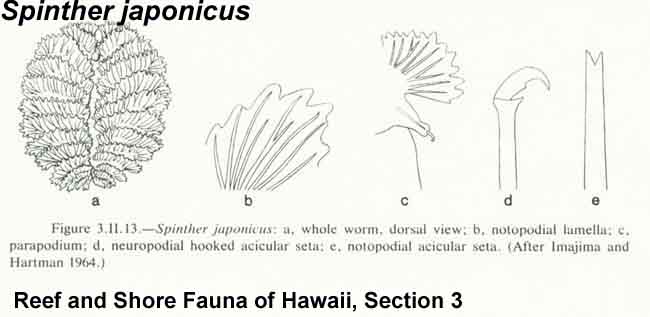
My frustration came when I tried to search for an image of Spinther purely out of curiosity. Below is the only image I could find:

I can see why it is compared to Spinther, but the resemblance is superficial even without a proper image. Below is a good quality image of Dickinsonia for comparison:
I would love to some day go through all the different interpretations of Dickinsonia, especially as there are so many, but when it was so difficult to find an image of Spinther  I am not sure it will be worthwhile. For the record, I go with Vendobiont. 

Thursday, 22 July 2010

The Garden of Ediacara: Book Review

I just finished reading Mark McMenamin's book The Garden of Ediacara: Discovering the First Complex Life and figured it might be interesting to review it. Initially I planned on doing a little review, after all, it is on one of my favourite subjects and had the potential to be a favourite of mine. Instead I found that I wanted to write about it in more detail. The book was published in 1998 so I am a long way behind in reviewing it. I will not criticise it in light of more recent information, as that is unfair when science advances so much (except where predictions are concerned) so I will largely critique the book as though it were brand new.

McMenamin gets off to a decent start in his first chapter, titled Mystery Fossil. The chapter seems to follow a chronological order, though he is found switching from topic to topic: where his interest in Ediacarans comes from; the origin of life; symbiogenesis; the Cambrian explosion; and more. There are a couple of hints at where the rest of the book might be heading as he emphasises the endosymbiotic views of Margulis and it is clear in retrospect that McMenamin fancies himself as a big ideas sort of guy. This is not a fault, but it does run the risk of becoming self-indulgent. His Hypersea theory gets a brief mention, something which I know little about and this book oddly enough did not properly discuss it. Ah well, on to the Ediacaran forms.

The second chapter, The Sand Menagerie, had me enthralled. McMenamin races through numerous different Ediacaran fossils from medusoids, to Tribachidium, to frond fossils, to Erniettids, to Rangea, to Dickinsonia, to Spriggina, to sponges, through Ausia, Corumbella, Inaria and Arkarua. If you are interested in Ediacaran forms, then this book may be worthwhile even if you only read this chapter. Sometimes when reading popular science the reader just wants to be shown things and told what they are with no need for rhetoric with the aim to persuade. This chapter succeeds in presenting the fossil forms, along with some very useful images (which may have been embellished a tad) without seeming to assert the author's strong views.

Chapter 3 continues the good form. Vermiforma gives insight into the work of an palaeontologist, particularly one interested in the enigmatic Ediacaran (a phrase which somebody should trademark; interestingly it is never used by McMenanim in this book, to my recollection). The author starts by showing and discussing his field sketches, something all palaeontologists do, and gives an idea of the sort of work involved. The chapter does a great job at showing how difficult fossil interpretation can be and how dramatically they can change, particularly for Ediacaran fossils. This is precisely what I like to see in books on palaeontology, an insight into the techniques used and how human interpretation is.

The previous chapters ranged from 10 to 36 pages, just what one would expect and I would not have minded if some of them had gone on for longer. Then chapter 4 came along, sitting pretty at 60 pages. I've already used the phrase "self-indulgent" in this review, but that is the perfect way to describe the chapter entitled The Nama Group. McMenamin goes overboard, quoting large chunks of his notebook which seems to contain descriptions of every little thing he sees. Hot dog stands, plants on display, birds flying. I'm not even completely sure what he was doing the whole time. It was tedious. Immensely. Frustratingly the colour plates are largely from this section, showing images which look like holiday photos rather than showing the fossils which you likely wish to see if you bought the book.

If you wade through his waffling, you will find tidbits of information dotted around. There are also some chunks which are very interesting but which are drowned out by the rest of the text. Twenty two pages in and there is a worthwhile discussion of Seilacher's views on Pteridinium (Seilacher features a lot in this book, both in descriptions of events and of interpretations, rightly so). One of the highlights of this chapter, if you pay attention, is the hit and miss attempts at trying to make a cast of a slab of Pteridinium fossils, another insight into professional palaeontology, but one you would be forgiven for missing. On pages 86 and 87 (twenty six and twenty seven pages in to the chapter) is a good little discussion between Seilacher, Gehling, Runnegar and McMenamin, all big names in the world of Ediacaran palaeontology but with some very different views. Despite having waded through the first half of the chapter, I would have been happy if this discussion had gone on longer. The next thirty pages of chapter 4 sees more irrelevant description littered with occasionally useful nuggets of information and then a little discussion between Seilacher and Pflug (another big name).

The fourth chapter had left a bitter taste in my mouth, I had grown weary of McMenamin, perhaps made worse because I was really enjoying the book before that. If I wanted to read a poorly written travel journal I would have looked for one away from the palaeontology section. If you decide to read the book for yourself it might be an idea to skip chapter four; I get the feeling that I might have enjoyed the book more without it.

Chapter five, titled Back to the Garden, discusses one of the main themes of the book, as the name suggests. It looks into McMenamin's "Garden of Ediacara" hypothesis which posits that many of the Ediacaran forms were symbiotic organisms feeding through both osmotrophy (absorbing nutrients from the water) and different variations of autotrophy through unicellular symbionts (some may have used photosynthesising bacteria or protists, others may have adopted chemosynthesising bacteria). It also suggests that things were peaceful in the "Garden" with very little predation. McMenamin makes quite a compelling case, addressing many of the criticisms aimed at his hypothesis. I found it to be a very interesting and plausible view, but as Richard Fortey had pointed out, it is not really falsifiable (McMenamin pretty much waves this criticism away). This chapter is a good example of the theoretical side of palaeontology, with the bonus of a description of an experiment carried out to test some of the views, showing the experimental side of the science. This chapter appears to be a return to form, however, there is the unsettling hint that McMenamin may begin indulging himself in a different way.

Cloudina is the title of the sixth chapter, one which seems to pass by with little incidence. I hate to say this, but I don't remember much about it. There is mention about the possibility of predators in the Precambrian and a little about the rapid evolution of eyes, but this chapter really does just seem like filler and I can't put my finger on why. Shame really, I like Cloudina. 


The transient feeling of the last chapter may be partly due to chapter seven, Ophrydium, which is also short but packs in information about colonial protists which shed light on the plausibility of the author's "Garden of Ediacara" hypothesis. This was another section which McMenamin could have expanded upon but did not, it would have been interesting to say the least.

Reading chapter eight was no surprise, McMenamin had named the Precambrian supercontinent Rodinia and was naturally going to talk about it. I do find palaeo-geography interesting, it is invaluable knowledge for palaeontologists and much of the information comes from studies into ancient organisms. The problem is, when it is discussed in popular science books it is very difficult to follow what is going on. The placement of the continents is very visual, yet popular treatments are distinctly lacking in images. Even Fortey's descriptions in Trilobite suffered from this problem. This may be a personal issue, perhaps I am simply rubbish with descriptions of continents. This chapter was interesting though and McMenamin's surprise at the accuracy of some claims of The Urantia Book is worthwhile reading.


By chapter nine things had gotten more interesting again. The author goes back to a more anecdotal style, though this time it can be forgiven as it gives yet more good insight into palaeontology. He describes repeated failure to find fossils, along with the problems of finding funding, only to then make a big find due to a sequence of serendipitous events. This sort of narrative is common when talking to palaeontologists; scientific knowledge and skill are balanced with luck and patience. McMenamin also gives good examples of how the press can completely mess up when reporting on science. My only issue with this chapter came right at the end, when the author proposes a rule which he unsurprisingly calls "McMenamin's Rule" which states to "[always] make scientific rivalries work to the benefit of science". Although I agree with him, after hearing about his Hypersea theory, Garden of Ediacara hypothesis and his naming of Rodinia, I couldn't help but think that he is either desperate to be heard or was showing off in a sense. I also couldn't help but feel that I may have thought differently if he had excised the unnecessarily large fourth chapter.

Chapter ten puts an end to the return to form. Titled The Lost World, it starts with a couple of quotes, just as the other chapters did, however, they seem irrelevant to the chapter which follows. One is a statement from Richard Fortey, pretty much a paraphrase of the previous criticism from Fortey which was left largely unaddressed. The second quote is one from McMenamin and his wife, only the second chapter to start this way and there are three altogether; perhaps he took George Bernard Shaw seriously when he quipped "I often quote myself. It adds spice to my conversation." The chapter discusses what to name the period at the end of the Precambrian, something which is important but just felt like McMenamin wanted to have his say on every little topic tied to the Ediacaran (he proposes it should be called the Lipalian in honour of Charles Walcott who discovered the Burgess Shale).

It may not be surprising that I approached chapter eleven, A Family Tree, with some trepidation. I expected McMenamin to propose that he simply knew the solution. I wasn't far wrong, but I was very pleasantly surprised with this chapter. McMenamin briefly discusses some of the views concerning the classification of Ediacaran forms, then puts forward his own revelatory hypothesis of the development of Ediacaran forms which gives a natural way to classify them. He gives an illustrated description of these forms starting as cell families  and developing through iterations. Vary the number of cell families, the number of iterations and their directions, and you end up with a wide possible diversity of forms, many of which are found in the Ediacaran. Under this view, the Ediacaran forms are not quite multicellular, they are metacellular, and diverged from all other animals before the development of the blastula. Intriguing stuff.

I said before that McMenamin fancies himself as a big thinker. Chapter twelve, Awareness of Ediacara, sees him thinking in ways for which the appropriate adjective is not "big". Put simply, he believes that what he calls cephalo-Ediacarans were on an evolutionary path to intelligence, an example he goes on to consistently cite as convergent evolution. This chapter was ill placed, it seemed to pop out of nowhere and lacks the necessary support that such a wild claim needs. The next chapter could have done with going before it, but that would have changed little.

Chapter thirteen, Revenge of the Mole Rats, is about convergent evolution. McMenamin sits in the Simon Conway Morris camp which asserts that convergence and constraint are so ubiquitous that the evolution of intelligence is inevitable. Much of McMenamin's chapter reads like Conway Morris' work, with examples of iterative evolution and talk of teleology found throughout. He addresses the views of Pierre Teilhard de Chardin, whom he seems to respect a lot, despite the usual negative views towards him. His own religious views are never made clear, but he is certainly sympathetic towards Teilhard's Omega Point  concept and accepts a view of static teleology in nature. Interestingly this reminded me of Stephen Jay Gould's research into the Piltdown conspiracy as he concluded that Teilhard was the culprit. It had me wondering if Gould was following the evidence or whether his desire to eradicate the spectre of teleology led to him wanting to discredit one of its main supporters. Teilhard had publicly debated George Gaylord Simpson, a mentor of Gould's, on this very subject, and Gould has written at length about the lack of direction he sees in evolution.  McMenamin sits at the opposite end of the spectrum to Gould and this chapter encapsulates his arguments on the topic; worth reading if you are already interested in this.

McMenamin ends his book with an epilogue about parallel evolution, one which seems pretty pointless, much like large chunks of this book. Overall I would recommend it if you are interested in Ediacaran forms as there are so few books which discuss them. I would also recommend it if you like to hear strong views about palaeontological interpretation and the bigger questions of evolution. The book shows that McMenamin sees himself as a big thinker, but that he lets his wild ideas get the better of him at times. This can be useful, as it means other scientists will scramble to get rid of any nonsense and will uncover new information as the boundaries are pushed.

Sunday, 27 June 2010

Parvancorina - the critter of today and many other days.

This organism is rapidly becoming a favourite of mine, so perhaps it is time for Microdictyon to move over. I inadvertently stumbled across Parvancorina whilst researching purported soft-bodied Ediacaran trilobites and ended up writing a fair bit about that instead, see here. It is surprising that little is said about Parvancorina outside of specialist literature, for example the Wikipedia page says very little at all and McMenamin's book The Garden of Ediacara has it on only a couple of pages. In comparison, Spriggina is very well known and almost always mentioned when potential arthropod/trilobite ancestors are brought up, despite the difficulties with such a classification. Parvancorina  remains a better bet, despite its own difficulties, yet it is little known.

Parvancorina is from the Ediacaran period and is one of the many problematic species from that time. It is shield shaped and has ridges which can be quite large in unflattened fossils. Some impressions suggest that it had 10 pairs of legs, perhaps optimistically seen as biramous by some.

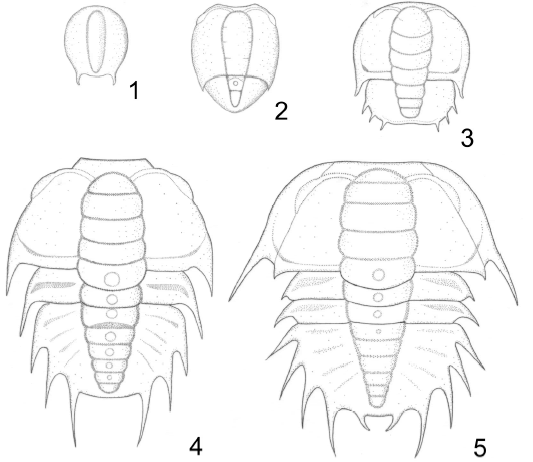
Like many other Ediacaran forms, Parvancorina has been known to dominate entire beds and is found to have faced into oncoming currents. This behaviour may have implications on the possibility of it being an ancestral trilobite, as trilobite larvae in the "protaspid" stage are planktonic as can be seen in the image below.


The support for Parvancorina being a potential ancestor to arthropods, particularly trilobites, comes from its resemblance to the protaspid stage of many trilobites. The protaspid stage is the earliest stage in development where the trilobite has a calcareous shell and is not segmented. For more on trilobite ontogeny see here. Primicaris  was originally thought to be a larval naraoid trilobite before becoming its own taxon, which is a potential link between Parvancorina and the trilobites. 


If the link to the trilobites is true, then the central ridge and lobes may be analogous to the gut system of trilobites. The picture on the right shows the protaspid stage of a trilobite (a) though it should be noted that there are a wide range of protaspid morphologies amongst the trilobites. For examples, see here and here (image compares Parvancorina on the left, Primicaris in the centre, and a protaspis on the right).

The link to trilobites may never be fully established. Based on morphology alone the connection to the trilobite protaspid stage is quite convincing, however, behavioural evidence (facing the current) and the way they develop must not be ignored. Either way, this is a fascinating critter which does not get enough attention. Below is an image of Parvancorina with Vendia. 


Saturday, 26 June 2010

Return of the Soft-Bodied Ediacaran Trilobite!

I previously wrote about a mention of a soft-bodied Ediacaran trilobite in a couple of textbooks which perplexed me, see here. Whenever I come across this organism being mentioned somewhere it is likely that I am going to mention it here and will repeat the information I found about it. In this case I was reading The Garden of Ediacara by Mark McMenamin and found "Soft-Bodied Trilobite" discussed on pages 35 and 36. This unnamed organism was found in the early '90s by Jenkins and Gehling and looks to be one of those forms which will always be controversial in interpretation. There are about 7 specimens of about 9mm in length.


It does indeed resemble a trilobite as it has an apparent cephalon (the head) which appears to have eye ridges and a glabella between them. The body is a broad thorax with 21 segments and the initial report mentioned a pygidium (the tail bit). There are also many differences. The individual segments get larger away from the midline and reportedly have faint, regularly spaced lines perpendicular to the width, a trait which is typical for Ediacaran organisms which are seen as quilted in structure. 

No legs are preserved on this soft-bodied fossil, so it resembles a discarded trilobite shell, however, it cannot simply be a shell as there is no evidence that it was shed. It is even mentioned by McMenamin that it resembles a trilobite trying to expand its surface area to increase absorption, perhaps even for light.  It may be (especially under the Vendobiont view of Seilacher) a shortened frond fossil, perhaps juvenile, however, the purported cephalon is an issue for this view. If it were a Vendobiont (also referred to as Vendozoa) then it could potentially still be a head, but with the implication that these non-animals also achieved cephalisation independently of animals. They converged upon the concentration of sense organs at the anterior end. 

"Soft trilobite" is one of those fascinating mystery fossils which gets thrown about from one kingdom to another, seemingly resembling members of each and at the same time nothing is like it. If it is an animal then it is very weird and mysterious, with potential arthropod affinities; if it is a Vendobiont, then it seems they were converging on heads and concentrated sense organs. Then again, it could be something completely different. 


Tuesday, 18 May 2010

Attack of the Mysterious Soft-bodied Ediacaran Trilobite

This morning, just before leaving to go to breakfast, I had a quick flick through a couple of pages of Invertebrate Palaeontology and Evolution 4th Ed. by E.N.K. Clarkson, a textbook I recommend for anyone interested in invertebrate palaeontology. As expected there are a few pages on the Ediacaran fauna, including a picture with familiar organisms such as Spriggina and Dickinsonia. Also on the picture was an organism labelled "soft-bodied trilobite". This stuck in my head a little bit through the day (to the point where I mentioned it to someone). Later on I was round at a friend's house and looked in the book Invertebrates 2nd Ed. by Brusca and Brusca where I found the same soft-bodied trilobite image (one I sadly cannot find online). Well, I had to know more.

I was sure that there were no trilobite fossils in the Ediacaran, so I have had another look through Clarkson and found both a reference to a paper and the mention that several fossils had been found resembling trilobites and with several stages of growth. Thankfully Clarkson states that further evidence is needed to assess whether it is a trilobite ancestor. I am a bit busy so I cannot research it into much depth, but what I have found suggests that these fossils are unnamed and simply labelled "soft-bodied trilobite" wherever mentioned. I cannot find a link to the paper mentioned in Clarkson online, but here is the reference:

Jenkins, R.J.F. (1992) Functional and ecological aspects of Ediacaran assemblages, in Origin and Early Evolution of the Metazoa (eds J.H. Lipps and P.W. Signor). Plenum Press, New York and London, pp. 131-176.

The "soft-bodied trilobite" is thought to resemble the Redlichiida (a group of early trilobites) yet has affinities with other Ediacaran forms such as Archaeaspinus (left), Dickinsonia and Vendia which are not thought to be connected to the arthropods.

Claims of putative Ediacaran arthropods are not uncommon, though scrutiny tends to find that either that interpretation meets some difficulties or that there is not enough evidence available. They are almost always connected with the trilobites when claimed as protoarthropods. Among them is Spriggina (right), though its symmetry is not strictly bilateral like that of arthropods as the two sides are offset. I have previously discussed Bomakellia. Others include Marywadea and Parvancorina. The latter is a very interesting one as it may indeed be connected to the arthropods.

Parvancorina  is perhaps too primitive in body plan to be considered arthropodan. There are fine lines on some specimens which have been interpreted by some researchers as paired limbs, but without this data a connection is tentative at best. The biggest issue with identifying an ancestor is the lack of leg preservation (this does not mean they lacked jointed legs, as trilobite fossils rarely have them too). Parvancorina  is thought to resemble the Cambrian arthropod Primicaris, which in turn is thought to resemble a Cambrian trilobite protaspid (the early stage of trilobite growth in which there are no segments) suggesting that heterochrony (changes in developmental timing) may have played a large part in early arthropod evolution (though it should be noted that the growth of Parvancorina is different to that of arthropods).

The earliest known trilobites are Eofallotaspis (left) and Protofallotaspis. Both are fully formed trilobites, though there are Cambrian arthropods such as Skania  and the aforementioned Primicaris  which may even be intermediate forms. Below is an image showing a potential evolutionary sequence from Parvancorina through to an early trilobite:

 On the left is Parvancorina, unsegmented and showing simple metamorphosis (each branch is demonstrating ontogeny). Next is Primicaris showing incipient cephalisation. Naraoia comes next, with complete cephalisation and a still unsegmented body. Then we see Kuamaia  (a helmetid) which shows a clear division between cephalon, thorax and pygidium. Finally there is Redlichia  which has additional trilobite features. This image is not a case of simply lining up fossils and hoping they fit together in a sequence; it is based off of trilobite ontogeny and makes a strong case for Parvancorinomorphs being a basal clade of the arthropods. 

What was intended to be a bit of a rant about Precambrian soft-bodied trilobites instead taught me a fair bit about the origins of arthropods, which is a good way to end the day I think.

Friday, 14 May 2010

Evolving Passions

I've been told that doing a course in palaeontology means I will end up changing my mind several times about what I would like to study. This is a brief run through the different things I have wanted to study within palaeontology over the years.

When I was young it was unsurprisingly dinosaurs which got me interested in palaeontology. I was an absolute dino-nut. I wouldn't even pay attention to pterosaurs, plesiosaurs, ichthyosaurs and mosasaurs because they weren't dinosaurs and used to cringe when people called things like Dimetrodon  a dinosaur. Even the gigantic mammals of the Cenozoic did not do it for me. I think dinosaurs had something exotic about them; they were unusual creatures, but not too unfamiliar. As far as I remember, I had three favourite dinosaurs. On the left is Deinonychus which I possibly discovered properly just after being scared by the Velociraptor  scene in Jurassic Park. That kitchen scene is still one of my favourites. I fell in love with all dromaeosaurs and probably would have been very happy studying those.

Another favourite among the theropods was Allosaurus. I was never a big fan of T-rex, possibly just because every kid knows what T-rex was. I probably wanted to be different and not just favour it, yet I was also drawn in by the large theropods. Thankfully this is no longer my passion. I still absolutely adore these creatures, but dinosaur palaeontology is a very competitive field, even more so when you look at the popular theropods.

 The third of my favourites was a stegosaur. I don't remember the exact reasons I fell in love with this one, but it is Tuojiangosaurus (try saying that when you are drunk). Again, I have no desire to study these beasts any more, despite the fact that I fell in love with palaeontology because of them.


Over the last few years I have been learning about the theory of evolution, which reignited my passion for palaeontology. I knew that I wanted to study evolution in organisms I liked. My favourite transitions included fish to amphibians and dinosaurs to birds. I would have loved to study things like Tiktaalik  or take a look at the famous Archaeopteryx  specimens (I still would, but don't mind if it is not for academic reasons). My favourite though is the early evolution of mammals, possibly the most beautiful transition I can think of.
So, I started my course wanting to study evolution and it was the vertebrates which really drew me in. I probably couldn't foresee any change to this even though I knew it would be a difficult area to break into. At one point I was asked by my tutor what my favourite invertebrate fossils were and I quickly answered "trilobites" without giving it much thought (the one on the right is Ctenopyge). I then started wondering if I would enjoy studying something other than vertebrates, with trilobites being the favourite of course. The answer seemed to be yes. I had gone from dinosaurs, to vertebrate evolution, to trilobites. Fortunately trilobites did evolve and are excellent for studying evolution (though all palaeontology is concerned with evolution anyway).

Since then it has taken yet another twist. I have become fascinated with organisms which came before chordates arrived on the scene (at least from what we see in the fossils) and before even trilobites (though occasionally people think they have found proto-arthropods and compare them to the trilobites). Early metazoan evolution is what is currently fascinating meaning that I have started liking the enigmatic Ediacaran fossils along with the small shelly fossils (SSFs). I like the Cambrian explosion too, but it is what came before that which fascinates me. I remember the first time I saw the Ediacaran fauna and the SSFs; I thought the former were interesting to know about but boring to study and the latter looked rather dull.


I am at the end of the first year now, I have had all of my lectures until September. I wonder what else I will become fascinated with. There are aspects of palaeontology that I find dull, but I know that can change (I recently said gastropods were boring and taphonomy has never thrilled me). I've gone from dinosaurs to vertebrate evolution, to trilobites, to early metazoa, where next?  I know I will always be drawn to evolution, for which I can study almost any group of organisms in the fossil record (invertebrates being the best). I've also been getting interested in the palaeoecology of the Zechstein sea, though that is likely just a personal thing on the side. Where next? We shall see....

Wednesday, 5 May 2010

Today's Critter: Bomakellia

Today I spent most of my time looking at Cretaceous rocks, so it would not be surprising if I said this critter was Cretaceous. It wasn't. Not even close. Bomakellia kelleri is another fascinating fossil of the Ediacaran fauna, dated to 555 million years old. It is known only from this 9cm long specimen:
It was originally classified as a potential arthropod, possibly even a primitive trilobite or anomalocarid. If it had arthropod affinities then it was certainly primitive. The possible semicircular cephalon and tri-lobed appearance may link it to trilobites, though it does not have segmented limbs or antennae (which may be due to its primitive nature or due to preservation as these parts often do not fossilise in trilobites). Trilobites also have gills on the body, which Bomakellia may be sporting, though this has been a possible connection with the anomalocarids. Below is a reconstruction which fits with the arthropod interpretation:
More recently, as with many of the Ediacaran fauna, it has been interpreted as a possible rangeomorph. The most famous rangeomorph is perhaps Charnia. Rangeomorphs have a frond like structure and were possibly colonial animals, attaching themselves to the sea floor by a hold-fast (interpreted as the head when classed as a proto-arthropod). Spriggina is another Ediacaran organism which has been seen as both a possible arthropod with trilobite affinities and a rangeomorph. Below is Bomakellia reconstructed as a rangeomorph:

Sunday, 2 May 2010

New End-Ediacaran Species From 2009

This is Cloudina carinata which has been discovered in Spain and is an important fossil for understanding the evolution of skeletons. Unusually for such old fossils they have retained their three dimensional structure. They show evidence of asexual reproduction and are one of the oldest examples of reproduction in animals in the fossil record. It is still not known what Cloudina is and it has been compared to cnidarians and annelids.

Cloudinids are quite fascinating small shelly fossils. They are most often found near stromatolites, suggesting that they inhabited shallow waters and are never found in the same layers as the soft bodied Ediacaran fossils, even though there are deposits where they alternate, suggesting that they inhabited separate ecosystems. Seilacher suggested that they lived in microbial mats and that they built up their tubes in response to sedimentation, needing to grow in order to stay above. Their shells often show signs of predation and there are signs of budding, suggesting a colonial existence. They remain some of the most mysterious yet important fossils found.

The article can be found here:
http://www.sciencedirect.com/science?_ob=ArticleURL&_udi=B6VBP-4XMD5PG-1&_user=10&_coverDate=01/31/2010&_rdoc=1&_fmt=high&_orig=search&_sort=d&_docanchor=&view=c&_acct=C000050221&_version=1&_urlVersion=0&_userid=10&md5=938a1343dd293215c55044478440d617

Monday, 19 April 2010

Thaumaptilon - Today's Critter

Today I decided to look at an organism called Thaumaptilon (wonderful soft-feather)  as it is believed to be a survivor from the Ediacaran fauna which was found in the Burgess Shale of the mid-Cambrian. This superficially leaf-like animal is considered to be a cnidarian and lived its life attached to the sea floor by a holdfast. It grew to around 8 inches and was covered in spots on one side which may have been zooids, suggesting it was a colonial animal.


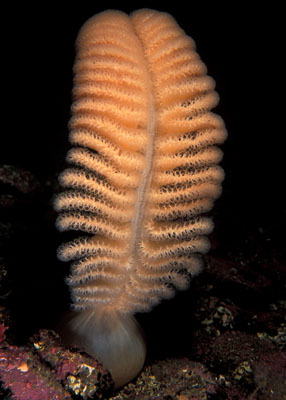
These animals were once thought to be sea pens, like the one in the image on the right, however, this has been strongly questioned on numerous lines of evidence. So why have I chosen something which is similar to a sea pen and didn't really do much? Well, Thaumaptilon was linked to Ediacaran forms such as Charnia which had long been tricky to classify (it still is). If Thaumaptilon was indeed both related to Charnia and to modern pennatulacean cnidarians (sea-pens) then it would be strong case against the concept of the Vendobionta of Adolf Seilacher. Seilacher proposed that the Ediacaran organisms were an evolutionary experiment in multicellularity which left no descendants. He also proposed that these quilted forms, of which Charnia  was one, had a hard outer layer which explained why they fossilised so well. Modern sea-pens do not have this outer layer and so the link would have dealt a heavy blow against it.

This image shows Thaumaptilon  along with the Ediacaran forms Charnia  and Spriggina. Charnia is named after Charnwood Forest in Leicestershire where it was initially discovered (so I have managed to keep most of the critters British so far). Spriggina is quite fascinating as it has been classified as an annelid worm, a rangeomorph frond, an arthropod (possible trilobite ancestor), and a proarticulate. In this image is another Cambrian form, Stromatoveris, which has been classified as a ctenophore. The image below shows a potential phylogeny on which both Thaumaptilon  and Stromatoveris can be seen.
I wouldn't like to comment on the potential relationship with Charnia  at the moment. Current popular opinion seems to be that we just don't know. The Ediacaran and early Cambrian fauna are some of the most difficult to study enigmatic organisms known to palaeontology. Thaumaptilon may not have been doing much when it was alive, but from a palaeontological perspective it is fascinating.

Wednesday, 14 April 2010

The Palaeodoodler

I'm one of those people who often doodles little cartoony pictures, but rarely anything serious. I don't think I could ever be a serious palaeo-artist, however, I have decided to try my hand at some palaeo-themed comic stuff. I got the idea whilst doodling in a lecture and ended up doing a scene involving a crinoid. Sadly I don't have a scanner so I had to take pictures of them with a digital camera, so they are not amazing quality.

This was the doodle that got me started (I simply call it "Crinoid pub crawl"). For the record, crinoids are not flowers but are often mistaken for them. They are echinoderms, but we like to wind up a friend who is besotted with crinoids by calling them flowers. If I have no ideas I am likely to make a crinoid joke. I haven't gone for accuracy in most of the pictures, but I may do so in future. Articulate crinoids can actually move, there are free swimming types, but even the sessile articulate crinoids can crawl slowly along the deep sea floor. This one here, judging by my random choice of other organisms (the ammonite, the wannabe trilobite and the random filter feeder) would make it Palaeozoic and therefore not a member of the Articulata. Out of view at the top was a random Odontogriphus  which would put the scene in the Cambrian and make it incredibly inaccurate.

This is "Ediacaran Guess Who?" and I did actually draw a lot of semi-accurate Ediacaran organisms on the game board. You might be able to see them by zooming in. I've been getting quite interested in early metazoan evolution, so many doodles will likely be set in the late Precambrian and early Cambrian.

Another doodle from a lecture (you can tell as it is on lined paper). Also simply another joke about crinoids being mistaken for flowers.

In case it is not obvious, those are stromatolites. I don't think it is possible to go wrong with stromatolites really. If anyone points out that stromatolites cannot talk then they might get a slap.

I have a few more ideas to come, some of which are not as simple to draw. My main issue at the moment is that I don't have internet access in my house, so if I need to look anything up (particularly Ediacaran and small shellies) then I have to wait. Ah well, enjoy.