Just hours after having been tattooed, I went on a trip to Saltwick Bay near Whitby on the Yorkshire coast. After spending the day there, I have to say that it is one of the best locations I have been to for fossil collecting. You are guaranteed to find something; ammonites and belemnites are ubiquitous, joined by the promise of more tantalising finds such as ichthyosaurs and crocodiles. In addition to this the bay is geologically and ecologically attractive; there is plenty for all to see and do. This week has been a busy one for me, so this will be a quick photographic run through of the trip and the sites to see. I have not yet taken pictures of the numerous fossils I brought back, so those will be saved for the future.
The view on the left is the south of the bay where we spent the second half of the trip. The weather was not brilliant, it was actually quite cold, as I found when I ate my dinner.
This is the view to the north of the bay, which is where we started looking for fossils, finding hundreds all over the place.
If you know where to look on the north side of the bay you will come across some dinosaur tracks on a rock which has fallen from the uppermost layers. This one is likely an ornithopod dinosaur, though with most fossil tracks it is difficult to determine exactly what made it (except in rare circumstances where the animal itself has fossilised too).
Most of the fossils were lying around amongst the fallen and washed up rocks, though occasionally some good finds were impossible to extract. These belemnites look great, but from under this boulder they like to tease.
Many fossils can be found in situ, difficult to extract but great to look at. Examples like these belemnites are found all over the bay.
Around the rocks, especially in the water, can be found plenty of wildlife. I spotted lots of anemones in attached to rocks.
As we headed to the south in the bay, we came across a seal carcass which was rather big and had its head buried. It was not easy to spot, but when downwind of it the stench was obvious. I may blog on this again as I recently got the pictures from when I found a dead porpoise on the beach a few years ago (I have an odd interest in dead things and I don't just mean fossils).
One of the most interesting things to look at on the beach is this wrecked ship. It looks like a mangled carcass of metal waiting to be picked by scavengers.
Throughout the day rocks were falling from the cliffs, so we often stayed clear of them. Fortunately none as big as this one, being modelled by Dean, fell whilst we were there, otherwise I might not be writing this right now.
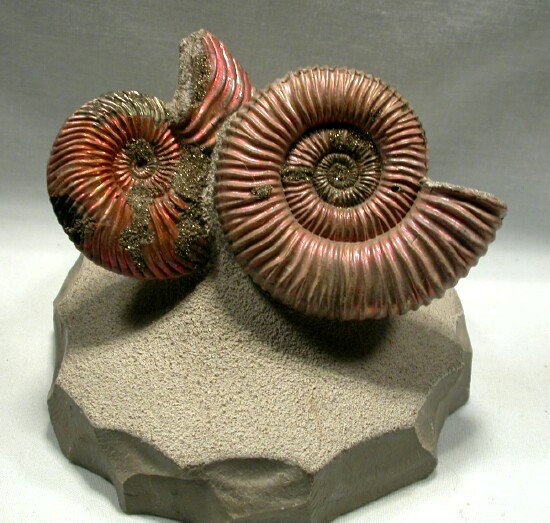
On the left is a rather nice pyritised ammonite, next to my foot. There were some interesting fossils found that day. A lad called Ben, who I met that day, was finding many crustaceans; there were hundreds of ammonites, belemnites and bivalves found, including an impressive ammonite by John; a couple we came across might have found some sturgeon bone; and the best find came right at the end whilst we were talking to a group about the fossils they could find, when suddenly one of the girls popped up with a fossil she had just found, wondering if it was anything worthwhile. She had a vertebra of an ichthyosaur. Naturally we went scrambling over the rocks where she found it in search of another, but to no avail. If you want beginner's luck, or just any sort of fossil finding luck, head to Saltwick Bay in North Yorkshire, you won't regret it.
Showing posts with label ammonites. Show all posts
Thursday, 19 August 2010
Saturday, 24 July 2010
Fossil Collecting: Fun, but not always fruitful.
Within the last couple of weeks I have had a couple of fossil collecting trips which have varied a lot. Both were enjoyable but couldn't be more different. One involved lots of people of a wide range of ages; the other was just myself and a friend. The first involved me searching through shale for fossils on a beach; the other had me looking at a limestone/dolomite cliff risking being nettled.
Runswick Bay - 15/07/2010
The first trip, on the 15th of July, was organised by Doncaster Museum and led by Dean Lomax of Palaeocritti. There were around 40 of us altogether, ranging from young children to the elderly. We went by coach to Runswick Bay, a well known fossil collecting locality north of Whitby, as can be seen on the map below.
It is not a place I had been before, though I knew the rocks would be of Jurassic age. There is also the potential for finding some quite random fossils, brought down to the bay by glacial erratics, but it is often best to stick to the shale in order to know what time period your collected fossil is from. We arrived at the bay in the morning to find that coaches could not get down the hill, forcing us to walk down a steep hill, so of course it rained on us. One thing I did find interesting on the trip down the hill was the paving slabs in the driveway of a house; they contained pseudofossils formed when magnesium oxide gets into cracks in limestone.The picture below shows a view of the bay:
When we were collecting fossils the weather cleared up. Some of the children started finding fossils straight away, their eyes seemed almost unnaturally attuned to spotting fossils. Rocks were repeatedly overturned, shale smashed and everyone went along at their own pace. It was one of those trips where everyone found fossils. It was very easy to come across casts of ammonites and bivalves, devil's toenails (Gryphaea) were common, along with occasional belemnites. One of the best finds was an ammonite mass mortality (Harpoceras I believe) and also a potential crustacean part (I reckon a crab) and some possible fish bones. I was also a little jealous when Dean found a chunk of rock with ripple marks; I do like ripples (and really should get the picture of me at Durdle Door next to some huge, uplifted ripples). Below is a picture of the group fossil hunting, you can see me on the left with my shorts, typical hat and big boots:
My own finds were nothing special (though all fossils are special in their own way) but then I really went just for the enjoyment of it. I have some ammonite casts, lots of bivalves (I always find bivalves) and a couple of belemnites.
South Elmsall - 20/07/2010
My trip to South Elmsall quarry was very different. South Elmsall is to the north of Doncaster towards Wakefield and happens to be just down the road from where a couple of friends of mine live. Whilst researching the geology of the area I found out that there might be fossils in South Elmsall Quarry from a paper I found online. From what I gathered from the paper, there was the possibility of finding more like those I have found in Conisbrough, plus a few others not found here. My friends who live near South Elmsall had asked me to come help them with some stuff, so I mentioned the possibility of me heading to the quarry at some point, to which they responded by saying I could take their youngest son out with me as he has just finished GCSEs and doesn't have a lot to do. So on the Tuesday we set out for about an hour to explore, with this map to guide us:
These two trips make an interesting contrast. The first had me finding things easily, coming away with a heavier bag even though I had emptied it of my lunch. The second had me coming back empty handed, which I don't mind too much as it is good experience; palaeontologists have to get used to disappointment as many of the best finds seem to be down to luck. In my opinion, going out and failing to find something to take home is more worthwhile than not going at all.
Runswick Bay - 15/07/2010
The first trip, on the 15th of July, was organised by Doncaster Museum and led by Dean Lomax of Palaeocritti. There were around 40 of us altogether, ranging from young children to the elderly. We went by coach to Runswick Bay, a well known fossil collecting locality north of Whitby, as can be seen on the map below.
It is not a place I had been before, though I knew the rocks would be of Jurassic age. There is also the potential for finding some quite random fossils, brought down to the bay by glacial erratics, but it is often best to stick to the shale in order to know what time period your collected fossil is from. We arrived at the bay in the morning to find that coaches could not get down the hill, forcing us to walk down a steep hill, so of course it rained on us. One thing I did find interesting on the trip down the hill was the paving slabs in the driveway of a house; they contained pseudofossils formed when magnesium oxide gets into cracks in limestone.The picture below shows a view of the bay:
When we were collecting fossils the weather cleared up. Some of the children started finding fossils straight away, their eyes seemed almost unnaturally attuned to spotting fossils. Rocks were repeatedly overturned, shale smashed and everyone went along at their own pace. It was one of those trips where everyone found fossils. It was very easy to come across casts of ammonites and bivalves, devil's toenails (Gryphaea) were common, along with occasional belemnites. One of the best finds was an ammonite mass mortality (Harpoceras I believe) and also a potential crustacean part (I reckon a crab) and some possible fish bones. I was also a little jealous when Dean found a chunk of rock with ripple marks; I do like ripples (and really should get the picture of me at Durdle Door next to some huge, uplifted ripples). Below is a picture of the group fossil hunting, you can see me on the left with my shorts, typical hat and big boots:
My own finds were nothing special (though all fossils are special in their own way) but then I really went just for the enjoyment of it. I have some ammonite casts, lots of bivalves (I always find bivalves) and a couple of belemnites.
South Elmsall - 20/07/2010
My trip to South Elmsall quarry was very different. South Elmsall is to the north of Doncaster towards Wakefield and happens to be just down the road from where a couple of friends of mine live. Whilst researching the geology of the area I found out that there might be fossils in South Elmsall Quarry from a paper I found online. From what I gathered from the paper, there was the possibility of finding more like those I have found in Conisbrough, plus a few others not found here. My friends who live near South Elmsall had asked me to come help them with some stuff, so I mentioned the possibility of me heading to the quarry at some point, to which they responded by saying I could take their youngest son out with me as he has just finished GCSEs and doesn't have a lot to do. So on the Tuesday we set out for about an hour to explore, with this map to guide us:
It was actually very easy to find and thankfully a lot of the cliff was exposed; a previous search on Google Maps made it look like the trip would be futile. The first thing you see when you approach the cliff are some excellent examples of stromatolitic domes. Formed by algae building up sediment, these domes resemble a lettuce in cross section. I did not have a camera with me, so sadly I could not take pictures, but here is an image from the paper:
This image is not particularly good, or at least it does not compare to how I remember them. There is no sense of scale (we are always told to make sure there is something to reference for scale at uni) and the typical graffiti at the bottom could be any size really. The stromatolites are worth looking at, so at some point I will go back and take some proper pictures. I looked around as much of the rocks as possible and found no fossils at all. No Liebea squamosa, no Dielasma elongatum. The paper had me thinking I would find many bivalves (Liebea, Bakevellia, Permophorus and Schizodus) along with bryozoa (Acanthocladia) but I should have been realistic, after all, many of these are meant to be in Conisbrough too but I have not yet found them. I did, however, find some casts which appear to have been Bakevellia binneyi as they were roughly the right size and shape, plus there were more than one of them. There was nothing I could take home with me, only the image of stromatolites and bivalve casts in my head. I intend to return, at least to take pictures, but I may also find something.These two trips make an interesting contrast. The first had me finding things easily, coming away with a heavier bag even though I had emptied it of my lunch. The second had me coming back empty handed, which I don't mind too much as it is good experience; palaeontologists have to get used to disappointment as many of the best finds seem to be down to luck. In my opinion, going out and failing to find something to take home is more worthwhile than not going at all.
Friday, 14 May 2010
Ammonites versus Trilobites: Icons of Palaeontology
It sounds like I am pitching a dodgy "monster" movie, though I feel such a film would not be too interesting for anyone but palaeontologists and marine biologists. Instead, I was thinking about which fossil group best symbolises palaeontology. Obviously dinosaurs are a popular choice, but really they make up a tiny but popular part of palaeontology. Both ammonites and trilobites are excellent choices as icons of palaeontology.
Ammonites are a superb choice as they are instantly recognisable and perhaps some of the easiest to draw as well. If I said "curly-wurly fossils" it is likely that most would know what I meant. They are also extremely useful in palaeontology, being used as zone fossils in biostratigraphy and helping us reconstruct what the Earth was like in the past. For more, see here. They are often used as the symbol for palaeontological and geological groups and societies. The Earth Soc at uni hand out a golden ammonite trophy for the winner of occasional events, the losing team gets a golden coprolite.
Trilobites are just as iconic and recognisable, but not as easy to draw. Many of their uses are the same as ammonites and for a full overview I recommend Trilobite by Richard Fortey.
A brief search of "palaeontology" on google shows how iconic these two groups are. The Palaeontological Society uses both of them, with an ammonite at the top on the tab, though the main logo has a beautiful trilobite:
The Palaeobiology and Biodiversity Research Group from Bristol university seems to make use of both ammonites and dinosaurs on their web page: http://palaeo.gly.bris.ac.uk/
The Paleontology Portal makes excellent use of the
ammonite shell. The Paleontology Society have a variety of things in their logo, but note that a trilobite is most prominent:
I honestly can't decide which is a better icon, both are worthy competitors.
Ammonites are a superb choice as they are instantly recognisable and perhaps some of the easiest to draw as well. If I said "curly-wurly fossils" it is likely that most would know what I meant. They are also extremely useful in palaeontology, being used as zone fossils in biostratigraphy and helping us reconstruct what the Earth was like in the past. For more, see here. They are often used as the symbol for palaeontological and geological groups and societies. The Earth Soc at uni hand out a golden ammonite trophy for the winner of occasional events, the losing team gets a golden coprolite.
Trilobites are just as iconic and recognisable, but not as easy to draw. Many of their uses are the same as ammonites and for a full overview I recommend Trilobite by Richard Fortey.
A brief search of "palaeontology" on google shows how iconic these two groups are. The Palaeontological Society uses both of them, with an ammonite at the top on the tab, though the main logo has a beautiful trilobite:
The Palaeobiology and Biodiversity Research Group from Bristol university seems to make use of both ammonites and dinosaurs on their web page: http://palaeo.gly.bris.ac.uk/
The Paleontology Portal makes excellent use of the
I honestly can't decide which is a better icon, both are worthy competitors.
Subscribe to:
Posts (Atom)