Showing posts with label ichthyosaurs. Show all posts

Tuesday, 26 October 2010

Doncaster, Ichthyosaurs, and Dodgy Journalism

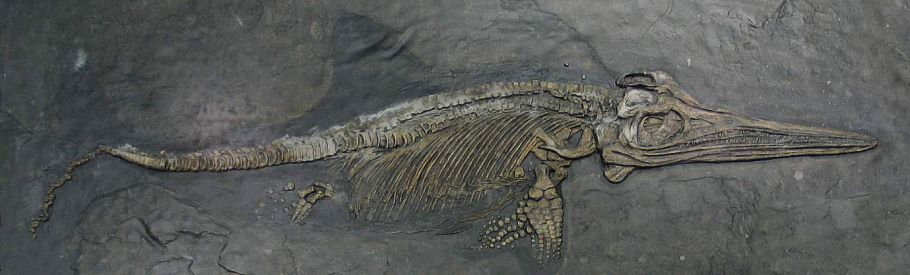
I always like writing about things which are close to home, whether it is my family home in Doncaster or down here in Portsmouth where I study. I've known about this particular piece of news for quite some time now and had a look at the published paper a couple of weeks ago. Finally the press release has been printed, so I can hop on that wagon and follow suit (erk, mixed metaphor). Up in the Doncaster Museum and Art Gallery is a beautiful ichthyosaur specimen known as Fizzy (chosen by a young girl in a competition) which is near complete and contains gastric contents - the last meal of the hapless marine reptile.

Aside from the specimen being beautifully preserved, it is also important for another reason. It extends the temporal range of Ichthyosaurus by 3 million years into the Pliensbachian (Early Jurassic). This incredible specimen had been in the museum collections for a few decades before my friend and colleague (can volunteers be colleagues?) Dean Lomax recognised its scientific worth.
Dean Lomax in Whitby, in front of a huge dislodged rock.

If I had the time I could flesh this out into an intriguing and insightful story about palaeontology, twisting and turning like a Thalassinoides trace fossil. We'd be able to look into the history of ichthyosaur discoveries, with such luminaries as Mary Anning making an appearance. We'd learn about the frivolity with which museum specimens used to change location, often with no information, rendering them almost useless to science. We'd hear all about how the specimen was misplaced, misidentified and misunderstood for many years, before it became pride of place on display in the museum. Major finds are usually thought to be done in the field, yet we would find that this one occurred in a small museum storage room. We could look at the preservation of the fossil and get insights into the life and death of old Fizzy. We could even take a look at Dean's career thus far and how he is taking what I call the "autodidact palaeontologist" route, now able to call himself a research palaeontologist with a peer reviewed publication under his belt (to see some of his other publications, check out Deposits magazine). We could also peer into the world of biostratigraphy, with the use of the belemnite to identify the age and location of Fizzy - information which was previously lost.

Instead, we can take a look at an area which some palaeontologists fear, one which can become hilarious and cringe-worthy - the press! Our local newspaper, The Star, mentioned the discovery on the front page and dedicated the whole of page 3 to it (imagine if The Sun did it, as if they were declaring fossils to be better than boobies!). I was once told that if you want to get quoted in a newspaper about palaeontology, or if you want an article published, then it is more likely if dinosaurs are mentioned. In an article on an ichthyosaur there is no reason to mention dinosaurs really, sure they were contemporaries and are not too distantly related, but their interactions would have been rare. In the article in question they are mentioned twice within the first two paragraphs, whilst also referring to Dean as Dino Dean. The article even contradicts itself by calling it a "sea dwelling dinosaur" but later mentioning that they are "often mistaken for swimming dinosaurs". They even get the news about the extra 3 million years wrong!

The Star press release.
So if you read the article you might wonder why a dinosaur expert is discussing a dinosaur which is not really a dinosaur and may get a little confused. Although the article is a tad ridiculous, it does bring publicity to our beloved museum and will hopefully cause people to come see Fizzy and the rest of the display collection.

Dean's article was published in Paludicola, a New York based journal. The press release can be seen here. Also check out Dean's site Palaeocritti for more details.

Friday, 13 August 2010

What's That Swimming Toward Me?

With the vast size of the Earth's oceans, it is not unlikely that many of us will swim in them from time to time. Whether you are going for an innocent paddle, catching waves on your surfboard, or sailing the seas on a fishing trawler or pirate ship, you will be sharing the waters with myriad different animals, some of which are dangerous. If you were to find yourself swimming under water with a big, moving animal coming ever closer, how do you know whether you have a friendly dolphin swimming towards you or whether it might be a hungry shark? Well, the easiest way can be done at a distance and is a simple observation with an interesting explanation - evolution.

So, with that large, looming shadow swimming towards you, what do you look out for? If you can see its tail, simply look at the orientation of the tail fluke, is it horizontal or vertical? Failing that, look at how it moves, does it undulate its body up and down, or does it move its body from side to side? Dolphins and whales have a horizontal tail fluke, which means they have to undulate their body up and down in order to propel themselves through water, so if you see either the horizontal tail fluke or the undulating movement, you have a dolphin or whale coming towards you. 
Sharks, on the other hand, have a vertical tail fluke and so must flex their body from side to side for propulsion. If you see the vertical tail fluke or side to side motion, then what is coming towards you is a fish and so might be a shark. 
Posture changes in dinosaurs.
As our fishy ancestors used a side by side motion to propel themselves through water, so did our earliest terrestrial ancestors and so do reptiles today. Snakes are an extreme example of this sort of movement, but the side to side motion is still there. During the Mesozoic era things began to change, as our ancestors (and convergently in dinosaurs too) developed a more upright posture, instead of the sprawling gait of reptiles. With an erect posture the more effective way to rapidly move is to flex the spine up and down whilst running, rather than side by side (see image below).

Many vertebrates have some of their vertebrae fused to facilitate particular movements, so future evolution can often be restricted to working within the confines of that movement. As dolphins evolved from terrestrial mammals, their semi-aquatic ancestors also used this up and down movement and so adapted this to movement in the water. Side to side motion, like that of a shark, would require a larger number of changes when there was the simpler solution of up and down movement (though note that evolution does not have the foresight, it simply uses what is available - quick fix solutions often work in evolution). The motion of whales and dolphins is testament to their ancestry, having descended from active land mammals. 

During the Mesozoic another group secondarily took to the waters and adopted the torpedo shape of dolphins and sharks. These were the ichthyosaurs, descending directly from terrestrial reptiles. As their ancestors used the side to side motion, so did the ichthyosaurs when they swam, also possessing a vertical tail fluke. They had some unusual traits for reptiles, giving live birth and being warm blooded, but their swimming motion gives away their reptilian status. This also quite ably demonstrates that they are not dinosaurs as many laymen mistakenly think, for dinosaurs did not have a sprawling posture which uses the side to side motion. So, if you are somehow in Mesozoic waters with a shape swimming towards you, it may be too late before you can discern whether or not it is an ichthyosaur or a shark.

Tuesday, 3 August 2010

Searching Through Dusty Old Books

It is not often that I can naturally weave several disparate interests into one post, but this one comes practically ready-woven. The interests in question are books, art, history and fossils, and this blog is the result of some of my time spent volunteering at Doncaster Museum. I've not been through to help out much, no more than twice a week and some weeks I don't get in at all, but as expected most of my time there involves looking at fossils. I've also spent some of my time there looking through their book collection at the books on palaeontology for anything useful and to get an idea of what's there. Many of the books are from the 1800s and early 1900s and so are scientifically out of date. It is quite interesting that there are duplicates of many of the books yet I can't fathom why.

A lot of the books have some breathtaking artwork adorning the pages, showing incredibly detailed renderings of fossils where nowadays we would simply have taken a photograph. A beautiful example of this is the ichthyosaur image below:
The particular book that this was in is quite the whopper as well, here it is being modelled by Dean Lomax:
Much of the palaeontological information in it was outdated, but the images are gorgeous and the information is still quite interesting. In this particular book, Memoirs of Ichthyosauri and Plesiosauri, Extinct Monsters of the Ancient Earth, by Thomas Hawkins, some of the prose is quite fascinating. There are elaborate descriptions which seem of no relevance to the aim of the book and seem almost like an acid trip in florid Victorian prose. If only I had copied some of it, it was a riveting read in its own way.

Some of the books piqued my interest for historical reasons, as seeing the name of a prominent scientist of that time can be quite exciting. The most exciting one perhaps is the book which contained contributions from many notable names. Off of the top of my head I remember Darwin, Huxley and Marsh in the book, yet I remember recognising at least double that. I'll have to go back and check it again. A common contributor to the books from the 1800s was Sir Richard Owen, who appears to have penned several monographs which the museum owns copies of. We took interest in his monograph on the pterosaurs, the front page of which can be seen here:
My favourite page in this monograph was the image of a Dimorphodon which folded out and appears to have been actual size:
It is perhaps a little sad that the information in the books was mostly useless to us, except if we wanted to trace historical changes in interpretations and classification. The artwork was exceptional, almost photographic in some and it is a shame that the same sort of time and effort is rarely put in these days. Finding the names of historically important scientists as contributors to books and journals was always interesting and of course, the subject being fossils they were not too dull to look through (some were, but then some scientists are so systematic that a huge, picture-less volume on bryozoa is hardly going to get you drooling).

Wednesday, 16 June 2010

Interesting News Round-up

I am going to try not to make the news round-up a regular thing, but having been to Download festival for several days means that I missed out on some news which I found interesting. So here it is.

Molecular Data Insufficient in Systematics?


A recent study has shown that molecular methods used for studies in systematics and evolution are not sufficient. The researchers amply demonstrate that methods such as using mtDNA (mitochondrial DNA) did not give enough of the picture to be relied upon alone. See the article here for details. Any ecologists who thought they were becoming obsolete due to DNA analysis can breathe a sigh of relief. Personally the idea that genetic data should be bolstered with other lines of data when constructing phylogenies seems obvious. At least now I can't be accused of having a bias towards wanting palaeontology to have a voice.

Mathematical Models and Multicellularity


This is something I really need to do more research into. The evolution of multicellularity is largely a mystery, particularly concerning differentiation. Individual cells are expected to act selfishly, making multicellularity a difficult trait to evolve. Multicellularity has actually been observed evolving, at least in a crude form, see here for details. But whether that study applies to the multicellular evolution in our ancestors remains to be seen. Now a mathematical model has been formed which elucidates this complex process. Through the evolution of developmental plasticity comes the evolution of differentiation. I would love to say more about this, but as I am not mathematically minded I would probably make a mess of things until I do more research, it is exciting though. Here is the simpler article.

More Insight into Abiogenesis


Recent experiments have successfully synthesised guanine, one of the nucleotide bases found in DNA and RNA. This is a big step as it much of the evidence supports the concept of RNA being the precursor of DNA and so far all RNA bases had been synthesised in prebiotic conditions except for guanine (those are adenine, cytosine and uracil). The experiments were elegantly simple, using UV light to cause the reaction. Not only did it produce guanine, but also facilitated the production of the other molecules as well. This is a big yet simple step in our understanding of life's origins. For more info check the ScienceDaily article here or the journal paper here.

Warm Blooded Ichthyosaurs


After looking at the gorgeous ichthyosaur fossil in Doncaster museum today this story was particularly exciting. Using techniques I mentioned in a previous blog, a team have determined that marine reptiles such as ichtyosaurs, plesiosaurs and mosasaurs were warm blooded. Again, for the ScienceDaily article see here, for the journal paper see here.