Thursday, 22 April 2010

Microdictyon Again

Yesterday I did not post a new critter and today has been the same, however, I do want to say more about Microdictyon. The small shelly fauna (left) of the early Cambrian are a group of fossils which are isolated hard parts, all small as the name suggests, and all are difficult to classify. Many of them are still mysterious, though occasionally discoveries are made which put some of them into context, often throwing up surprises. Microdictyon  means "little net" and was the name of a phosphatic microfossil in the early Cambrian. The microfossils have a distinct net like structure, hence the name.

It wasn't until fossils in 1989 were found with soft tissue preserved. Nobody could have predicted that it would turn out to be an armoured lobopodian. The sclerites were found to sit just above the lobopods, on each side, looking like shoulder pads. It is likely that they were used for defensive purposes, though it has even been suggested that they were compound eyes like those of trilobites.

Tuesday, 20 April 2010

Words Just Cannot Do Justice To My Incredulity

If you don't know who Kent Hovind is then I suggest you run a mile every time you see his name, he is perhaps the worst creationist apologetics has to offer. However, if you, like me, are building up an immunity to his drivel somehow, then try reading this. It turns out Kent posts imaginary conversations, usually quite self-aggrandising, on a blog site, which he writes whilst in prison. In this example he discusses with Ardi (if you don't know about Ardi then you are on the wrong site here). I don't want to say more, just read it: http://www.cseblogs.com/2010/04/19/knee-mail-“if-ardi-could-talk”/

Monday, 19 April 2010

Thaumaptilon - Today's Critter

Today I decided to look at an organism called Thaumaptilon (wonderful soft-feather)  as it is believed to be a survivor from the Ediacaran fauna which was found in the Burgess Shale of the mid-Cambrian. This superficially leaf-like animal is considered to be a cnidarian and lived its life attached to the sea floor by a holdfast. It grew to around 8 inches and was covered in spots on one side which may have been zooids, suggesting it was a colonial animal.


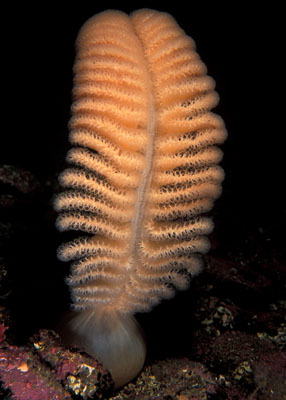
These animals were once thought to be sea pens, like the one in the image on the right, however, this has been strongly questioned on numerous lines of evidence. So why have I chosen something which is similar to a sea pen and didn't really do much? Well, Thaumaptilon was linked to Ediacaran forms such as Charnia which had long been tricky to classify (it still is). If Thaumaptilon was indeed both related to Charnia and to modern pennatulacean cnidarians (sea-pens) then it would be strong case against the concept of the Vendobionta of Adolf Seilacher. Seilacher proposed that the Ediacaran organisms were an evolutionary experiment in multicellularity which left no descendants. He also proposed that these quilted forms, of which Charnia  was one, had a hard outer layer which explained why they fossilised so well. Modern sea-pens do not have this outer layer and so the link would have dealt a heavy blow against it.

This image shows Thaumaptilon  along with the Ediacaran forms Charnia  and Spriggina. Charnia is named after Charnwood Forest in Leicestershire where it was initially discovered (so I have managed to keep most of the critters British so far). Spriggina is quite fascinating as it has been classified as an annelid worm, a rangeomorph frond, an arthropod (possible trilobite ancestor), and a proarticulate. In this image is another Cambrian form, Stromatoveris, which has been classified as a ctenophore. The image below shows a potential phylogeny on which both Thaumaptilon  and Stromatoveris can be seen.
I wouldn't like to comment on the potential relationship with Charnia  at the moment. Current popular opinion seems to be that we just don't know. The Ediacaran and early Cambrian fauna are some of the most difficult to study enigmatic organisms known to palaeontology. Thaumaptilon may not have been doing much when it was alive, but from a palaeontological perspective it is fascinating.

Sunday, 18 April 2010

Politics

For the record I am not really interested in politics, though I really should register to vote. Anyway, I have found my ideal party, who I hope I can vote for.


Trilobite Tattoos?

As I have tattoos already, the thought of a trilobite tattoo would be quite tempting. I found this website which shows some trilobite tattoos on others.

I am seriously going to look into this properly now...

Crinoids of the day

For today's critters it seems only fitting that they are crinoids. They have been mentioned a couple of times on this blog, but today brought a surprise with two (and now three) blogs on crinoids. The following is Protaxocrinus from the Ordovician. Protaxocrinus girvanensis can be found in Ayrshire.

The next is Diabolocrinus,  also Ordovician in age and found in Ayrshire.

A Crinoid Coincidence

Earlier today I posted about the crinoid poster I did for a uni project. Coincidentally I have just found an article on Science Daily which is not simply about crinoids, but about their evolution in response to predation. This information would have been useful for the poster as it was about the adaptive evolution of Palaeozoic and Mesozoic crinoids. The article in question is about the evolution of motility in Mesozoic crinoids in response to predation by sea urchins.

Evolutionary arms races are often postulated as the cause of rapid evolutionary escalations, however, they are not always easy to demonstrate. In an excellent study of both living examples and fossils, researchers from the University of Michigan have demonstrated that crinoids evolved their defensive strategies in response to being preyed upon by sea urchins (Baumiller led the research, who also led the research in one of the papers we cited in our poster).

Modern crinoids were quite recently found to be able to crawl away from stressful situations and reattach to substrate in a new location. Palaeozoic crinoids were unable to do this and so invested in stronger "armour" in order to provide protection. The researchers placed sea urchins in a tank with both crinoid fragments and living crinoids. They observed the sea urchins feeding on the fragments and the living crinoids. This confirmed that sea urchins do feed on crinoids and also provided the necessary clues for scrutinising the fossil record. The undigested parts bore characteristic teeth marks from the sea urchins.

The palaeontologists then analysed 2,500 stalked crinoids from the Triassic period, looking for the same bite marks and scratches. Over 500 had such markings, suggesting that predation by sea urchins was a strong ecological presence for early Mesozoic crinoids and the likely driver behind the evolution of motility.

The timing of the occurrence also has significance, as most examples of evolutionary arms races comes from the Mesozoic Marine Revolution, which occurred around 75 Ma later. For crinoids it appears that the arms race had long been raging due to the evolution of stronger, more active feeding apparatus in echinoids.

The journal article can be found here.

Adaptive Crinoids: Palaeontological Poster Presentations


A few months ago we were set the task, in groups, of producing a poster to be presented in front of the rest of the people on our course. At conferences scientists often do poster presentations of their recent work and display them so that other scientists can browse them and easily find out more. Our task was to produce the same sort of thing, albeit it on a smaller scale as there are only 11 of us on our course. The poster I co-produced is titled A Comparison of the Adaptive Strategies of Palaeozoic and Mesozoic Crinoids, however, on the day it tended to be referred to as Adaptive Crinoids. Our poster came joint first, which is why I feel it is worth sharing. As my prize I chose the superb book Wonderful Life  by Stephen Jay Gould. The picture may not be brilliant quality as I currently only have a trial version of powerpoint and so can't edit it to make it suitable. I can't even copy and paste the writing.


So there it is. There are a couple of mistakes, but nothing major. We seemed to get a good balance of information and aesthetic value. The poster should not be so wide, the black edges need trimming back in this image. If it is too hard to read that may be because it was made for A1 sized paper.

Saturday, 17 April 2010

The critter of the 17th of April

In a break from trilobites found in Britain, I think it makes sense to present the organism which is currently my profile picture.


This is Microdictyon, an armoured worm from the early Cambrian. It is often classed as a lobopod, though this phylum is not well defined. It is well known from fossils of its sclerites, with some soft-bodied fossils found in China. It has ten pairs of sclerites on its side, matching its pairs of tentacles, and the anterior and posterior are featureless (this image makes the sclerites look like eyes). There are 11 species of Microdictyon, one of which is amusingly called M. anus. 


I am becoming quite fascinated by early metazoan evolution, right up to the Cambrian explosion. Microdictyon  is one of the small shelly fossils of the post-Tommotian Maotianshan shales. 

Friday, 16 April 2010

Critters of 16/4/10

tesFor today I have gone for more trilobites, both of which are agnostids. Most agnostid trilobites are eyeless and have a similar sized pygidium as the cephalon, making it difficult to determine which end is which sometimes.

This first agnostid trilobite is Lotagnostus which is from the Upper Cambrian. Lotagnostus trisectus can be found near the Malvern Hills. It is sometimes known as Agnostus trisectus. 

This agnostid trilobite is Eodiscus punctatus, from the Middle Cambrian. It can be found in Wales and is sometimes referred to as Microdiscus punctatus. 

Thursday, 15 April 2010

Critters of the *blank*

I am surprised that I did not have this idea sooner as it is the sort of thing found on many blogs. I have decided to update more regularly, though mostly images and not too much writing. I shall be doing the "animal of the week" sort of thing, but a week seems like too long. Daily might get tedious, so the time period is irrelevant (hence the *blank* in the title). Of course, this being the Palaeobabbler it is only fitting that they are extinct critters. I'll probably post a mixture of fossil images and reconstructions, depending on what I find really. Some will follow themes (the first lot will likely be species taken from British Palaeozoic Fossils as I just got it out of the library) and some may be quite random.


This first specimen is Olenelloides, a gorgeous trilobite from the lower Cambrian. Olenelloides armatus can be found in British Cambrian rocks. I will apologise in advance for anyone who happens upon these posts who is not fond of trilobites, I am likely to put up a few pictures of them. Trilobites are incredible fossils and have such diversity that I could keep posting a new interesting one for quite some time.The most striking feature of Olenelloides is clearly the cephalon (the head part at the anterior), which is almost star shaped. I would love to find a fossil of this some day.

Wednesday, 14 April 2010

How Bitter-sweet!

I've not yet seen the film "Expelled" and am not sure if I have any desire to do so. I have seen clips and read some manuscripts, from what I can tell it is just a lot of rehashed arguments in film form. In the film it is claimed that professing creationists and Intelligent Design advocates are often booted out of academic positions.

This, however, is not quite true. There are creationists who have lost academic positions, but for the same reasons that non-creationists also lose academic positions; if you aren't good at your job you lose it. In his blog, PZ Myers points out that Michael Behe, a very prominent ID advocate, is allowed to keep his job in academia.

Is the creationist community as squeaky clean as they should be? If they are horrified by the spurious claims of creationists being expelled  from academia, do they allow evolution acceptance in their own circles? Apparently not! Prominent evangelical theologian Bruce Waltke has been forced to resign from his position at the Reformed Theological Seminary over a video where he stated that evolution was compatible with Christianity and should be embraced.

I read about this on Myers' blog and when he sticks to science his blog is highly recommended. However, his vituperate diatribe against compatibilism seems rather pointless.

The Palaeodoodler

I'm one of those people who often doodles little cartoony pictures, but rarely anything serious. I don't think I could ever be a serious palaeo-artist, however, I have decided to try my hand at some palaeo-themed comic stuff. I got the idea whilst doodling in a lecture and ended up doing a scene involving a crinoid. Sadly I don't have a scanner so I had to take pictures of them with a digital camera, so they are not amazing quality.

This was the doodle that got me started (I simply call it "Crinoid pub crawl"). For the record, crinoids are not flowers but are often mistaken for them. They are echinoderms, but we like to wind up a friend who is besotted with crinoids by calling them flowers. If I have no ideas I am likely to make a crinoid joke. I haven't gone for accuracy in most of the pictures, but I may do so in future. Articulate crinoids can actually move, there are free swimming types, but even the sessile articulate crinoids can crawl slowly along the deep sea floor. This one here, judging by my random choice of other organisms (the ammonite, the wannabe trilobite and the random filter feeder) would make it Palaeozoic and therefore not a member of the Articulata. Out of view at the top was a random Odontogriphus  which would put the scene in the Cambrian and make it incredibly inaccurate.

This is "Ediacaran Guess Who?" and I did actually draw a lot of semi-accurate Ediacaran organisms on the game board. You might be able to see them by zooming in. I've been getting quite interested in early metazoan evolution, so many doodles will likely be set in the late Precambrian and early Cambrian.

Another doodle from a lecture (you can tell as it is on lined paper). Also simply another joke about crinoids being mistaken for flowers.

In case it is not obvious, those are stromatolites. I don't think it is possible to go wrong with stromatolites really. If anyone points out that stromatolites cannot talk then they might get a slap.

I have a few more ideas to come, some of which are not as simple to draw. My main issue at the moment is that I don't have internet access in my house, so if I need to look anything up (particularly Ediacaran and small shellies) then I have to wait. Ah well, enjoy.

Saturday, 10 April 2010

Exploring the Zechstein Sea

I've lived in Conisbrough, a large village on the outskirts of Doncaster, for most of my life. Even so, I knew very little about the geology of the area until recently. As a child I knew that there were no dinosaurs to be found and that impressive fossils like ammonites were to be found at the coast. I also knew that I was in the heart of the South Yorkshire coal fields (Cadeby Colliery used to be in walking distance and Maltby still has a pit) so I could have guessed that Carboniferous rocks were nearby. Apart from that I also knew that there was a working dolomite quarry nearby, but not what age it was.

This Easter I decided to rectify that. Before returning home I had a look at some of the books in the university library, not really expecting to find much but still hopeful. I looked at the few books they had on the geology of South Yorkshire, mostly getting little information. Eventually I stumbled on a battered looking book from the '60s titled Geological Excursions in the Sheffield Region which contained a chapter titled "Conisborough". The spelling mistake irked me a little, but I read on, only to immediately happen upon them stating that fossils were rare in Conisbrough. Unperturbed I read on. Fortunately the book mentioned just one locality in Conisbrough where fossils could be found and I was determined to find it. The map given was poor and the descriptions of the route were heavily outdated, but still I checked it out of the library in hope.

Below is a better map which I found after finding the place for myself:


I set out looking for it with my friend Johnathan, we had plans to walk somewhere else afterwards but first we would look for fossils as it was on the way. The poorer map had us looking around 150 metres away at some bare rocks which matched none of the descriptions and clearly held no fossils. We had almost given in. As I used to go walking around here I knew of a place at the top of the hill which might just have been it, so we decided it was worth looking. When we got there we were not sure and we looked at a lot of the rocks up close but to no avail.

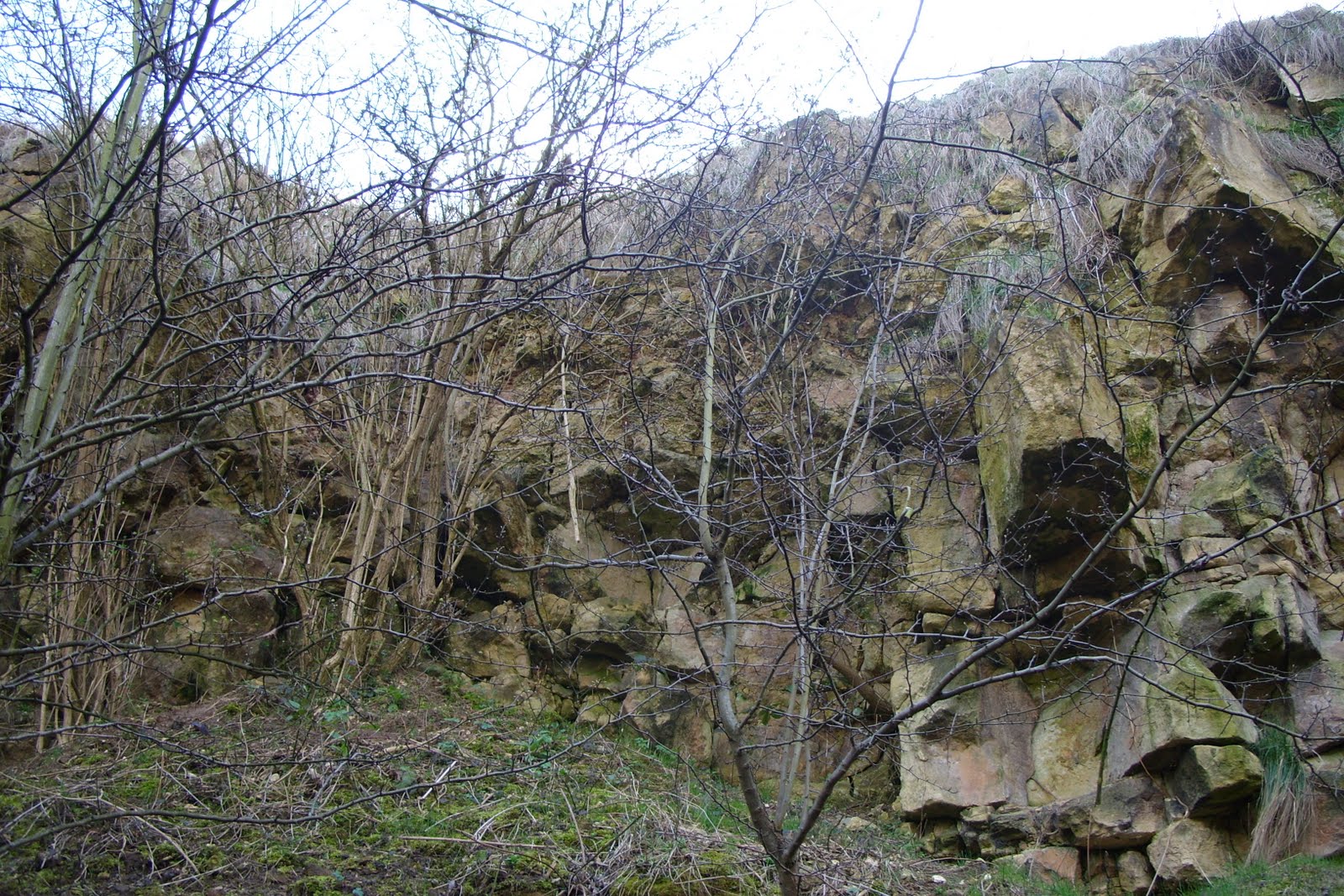
Up close there was a lot of interesting features on the rocks, but not the fossils we were looking for. We may have found shell casts, but with no actual shells we were not convinced. On the left is some of the interesting layering we found, including a lovely brick red colour at the top. It was around this point that Johnathan seemed to have given in. Continuing to look seemed futile and the place was not easy to get around. We were later to realise that this was the old Ashfield Brick-clay Pit, which is now only used by fly-tippers. This was useful for me in my youth as I travelled there in search of things to build dens out of; now it is a bit of a nuisance. Whilst Johnathan wandered off getting bored, I kept looking, having to do a little climbing in the slippery mud. I did find a couple of interesting features:


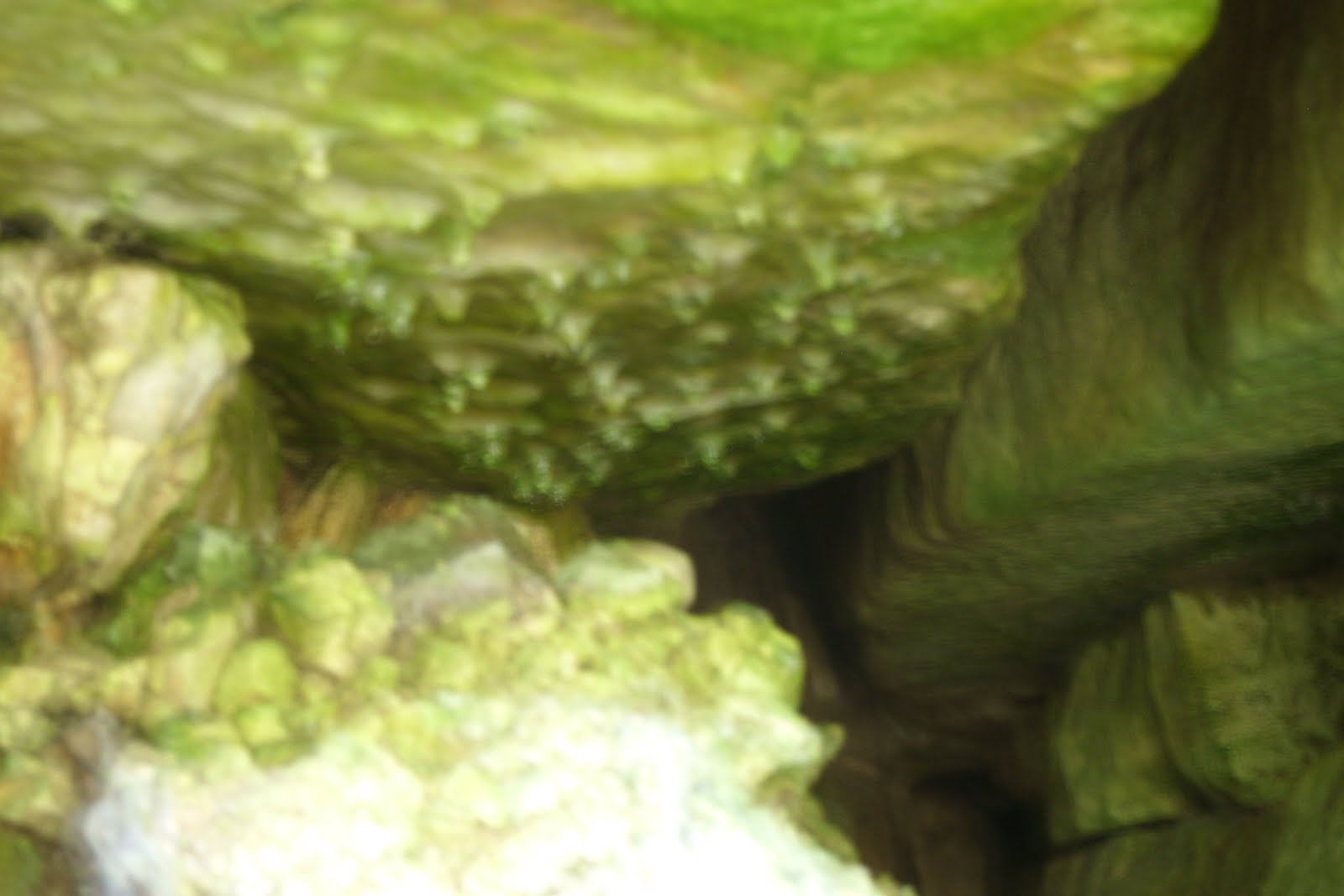
Above is a picture taken in what could be described as a small cave if I was being generous. What was interesting about it are the mineral precipitations from the ceiling. I can't help but wonder if any of the kids who burn their fires and drink there have ever stopped to admire this. On the right is an example of a quartz vein in the rocks there. They are surprisingly common when you start looking at the rocks, yet I reckon I am one of a handful of people who have stopped to appreciate them.

At this point I was enjoying looking at the rocks and the surprises they held. When I reached the place in the picture on the left I decided to have a look at some of the higher rocks and found myself climbing a very wobbly tree. I found some interesting clays and more quartz veins whilst I sifted through little rocks I found, hoping to find a fossil. Somehow I did it. I picked up a small rock and realised that I was probably holding an ancient shell. I shouted to Johnathan that I thought I had found something, but I really wasn't sure as I had a niggling feeling that I was seeing what I wanted to see.
It was then that I found another, which I sadly do not have a picture of as I gave it to Johnathan as a souvenir of our little expedition. I felt almost triumphant, I had succeeded. In my hands I held two little pieces of ancient history, long dead bivalve molluscs that have been fortunate to fossilise and survive hundreds of millions of years. I've had this feeling before as these were not my first fossil finds, but this meant more to me. Conisbrough will always feel like home to me and now I have a piece of its ancient history. Our fossil hunting was over for the day, so we continued on our walk with some sense of achievement.

My automatic reaction to this is to do some more research. I classified both of these specimens as belonging to genus Liebea but I may be wrong. It certainly does occur around here, but so does Bakevellia and to be honest I can't tell which is which in some examples. I am certain some of my later finds are Liebea, however, it was those that made me think the first specimen might not be. During my research I found this paper which I wish I had in the first place. It has a more detailed description of the rock exposure, is more up to date, and has a map which would have led me to instantly recognise the place.

A few days later I was playing guitar in church on Easter Sunday when I spotted Andrew, a friend I hadn't seen for a long time. After church we went over to the church hall for a cup of tea and a bit of a catch up. I can't remember how we got onto the subject of fossils, but when I said I had found some in Conisbrough his eyes lit up and his mouth dropped. Fossil hunting had become a hobby for him recently and he was even doing a project on them (he is an artist). I think he felt as I did, the thought of finding fossils in Conisbrough, the place of our youth, was exhilarating. It didn't take long before we were both thinking of heading there straight away, I feel like we read each others' minds. So off we set, myself with a guitar on my back, off to the Ashfield pit in search of ancient life.

When we got to the place I had found fossils Andi was using his keen observational skills. He suggested we looked in the area where the rocks had fallen for fossils which had come away from the rock face. I can't believe I had not done this myself, but then I am used to being told to look right up at a rock in order to identify sedimentary structures. As soon as he had suggested surveying the floor I spotted one, a lovely Liebea specimen. I showed Andi so that he knew what to look for and he went on to find four fossils of his own. I went up to my spot up the tree and came across my first brachiopod find, identified as Dielasma, along with a bivalve mollusc which has me baffled at the moment, as it does not fit with anything listed in the paper. Below are my finds up to that point. On the left is my first specimen. The other three are what I found with Andi. They are Liebea (the one which makes me want to reassess the first), Dielasma, and the unidentified bivalve.
After this I did more research. I already knew that I was looking at Permian rocks, so this put the fossils at around 250,000,000 years old. During the late Permian the Earth looked like this, as seen on the picture to the right. Conisbrough sits in an area which used to be the Zechstein sea, an area which stretches to Poland. The Zechstein sea was shallow and land-locked, containing many reef systems, particularly bryozoan reefs in this area it seems.

Predictably I decided I would go back at least one more time before heading to Portsmouth again. This time I went more prepared as I had a bag for specimens, a notepad and pen, and a camera to take pictures of the location. Partly simply to have documented it, partly in case others would like to explore the ancient history of Conisbrough.


This time I barely had to put in any effort. Spotting the fossils became so easy. I brought home around 20 this time and left a few there, keeping only my first finds and the most interesting ones. 
I'd love to spend ages putting up pictures of all of these, but I won't. On the left is a bit of substrate which I have kept in its original condition as it contains the mould of a Liebea specimen, along with two other shells, one of which is definitely a bivalve, but the other I cannot see enough of. After this are the bivalve specimens, one of which has what appears to be the original colouration. Over on the right are the brachiopods I collected, including the smallest which is a tiny 4mm in length. 

After I had found all of these I went to look at more of the rocks. I found no fossils but the rocks were interesting to look at. I also found a spot where an owl or another bird of prey might rest to eat occasionally, as I found numerous small bones. Judging by the jaw bones it was a rodent. Sadly the batteries in the camera died as I tried to take pictures of it, so I packed up and came home.

When I got home I documented them and eventually put them in a safe place (a biscuit tin). Over summer I will be returning to the place as there are species listed in the papers I have looked at which I have not found. For now I will have to wait though as I return to university in just two days. 

Saturday, 13 February 2010

A Tentative Taxonomy of Creation Beliefs; Where Do You Fit?

This is a potentially futile attempt to categorise the differing views held by Christians with regards to the mode of creation used by God. It likely came to mind after returning from a lecture discussing taxonomy and giving some thought to creation related issues. Some of my definitions may be disagreed with; some may even appear to be the same thing. I am curious as to how others would identify themselves. I shall present it as several sections which often divide into other, more specific sections. This only applies to Christians.

All beliefs listed here come under the title “creation” which is divided into 2 categories. Category 1 is termed “Biblical Literalism/Creationism”.

1.1)Young Earth Creationism (YEC)/Ultra-literalism: The belief that the Genesis narrative is to be read as literal history occurring 6-10,000 years ago. There was a global flood and scientific theories such as evolution and the big bang theory are rejected. Within this view there are those who accept ‘creation science’ which claims that scientific evidence supports a young Earth (the main topics being ‘Flood Geology’ and ‘Baraminology’). Many also use the ‘Omphalos hypothesis’ which suggests that God created with an appearance of age.

1.1b) Modern Geocentism: An offshoot of YEC that claims the Sun and everything else orbits the Earth.

1.2) Old Earth Creationism (OEC): The belief that the Genesis narrative is literal, but that long time spans do not contradict it. This is often referred to as ‘concordism’ and is divided into sub-categories.

1.2.1) Gap Theory/Creationism: Also known as ‘Restitution Creationism’, claims that life was created recently on an already existing Earth. They believe that the verses Genesis 1:1-2 indicate an indeterminate amount of time before the creation week begins in verse 3. Many also believe that before this was a primordial Earth, explaining the prevalence of fossils spanning billions of years. Gap creationists believe in a global flood.

1.2.2) Progressive Creation: Also sometimes referred to as ‘strong concordism’. Progressive creationists reject evolution as explaining life’s diversity, but often accept that it does happen, though God intervenes at the key events (which are usually subjectively defined under the definition “kind” and some would suggest whenever speciation occurs). Most reject a global flood, accepting instead a local one and many interpret us as being in the 7th day.

*) Day-Age: Not specifically a belief like the others, but is a hermeneutic worth mentioning. This is the interpretation of the days of Genesis to be longer periods of time. It is mentioned here as many progressive creationists take this view, but as it is a hermeneutic it is also used by many who are found in later categories.

2) Category 2 is termed “Intelligent Creation” as referencing the philosophy which is sometimes referred to confusingly as intelligent design. There are again two main sub-categories.

2.1) Neo-creationism: This is again divided and has much overlap with some of the other categories. This is generally the belief that science cannot sufficiently explain the phenomena it purports to, but unlike Biblical Literalism it does not rely on Scripture (though many of its adherents are literalists too).

2.1.1) Abrupt Appearance Theory:
The belief that the universe and the Earth appeared abruptly and the animals and plants appeared fully formed. They make no appeal to the Bible and generally do not accept a young Earth. This can often be indistinguishable from other forms of neo-creationism or from progressive creationism.

2.1.2) Intelligent Design (ID): This has also been termed “Science Denialism” and its proponents have been referred to as both “Intelligent Design Advocates” and “Science Critics”. This claims that there are features in the universe, particularly biology, which are better explained by a designer than by naturalistic mechanisms. The usual arguments are irreducible complexity; specified complexity (and information theory); anthropic finetuning; and arguments about improbability. I have divided this further into two categories.

2.1.2.1) Strong ID: This covers proponents who credit most of creation to the intervention of the designer but do not rely on the Bible for their justification. Many of their beliefs are creationist, but generally they reject this term.

2.1.2.2) Weak ID: This covers proponents who accept the scientific narrative of history but reject that it could be achieved without a designer intervening. Some of these accept evolution to an extent and even accept common descent (albeit aided by the designer).

2.2) Christian Evolutionism: Also termed “Accommodationism”, is the second category within intelligent creation. This covers all the Christian beliefs which accept evolution. There are many within this and some are hard to distinguish from others. I have also defined many of them myself as they tend to all be termed ‘theistic evolution’ in most literature, which I feel fails to encompass the diversity of beliefs held concerning the act of creation. I shall list them in order from what I perceive as the most conservative to the most liberal.

2.2.1) Weak Theistic Evolution: Proponents of this vary, though generally Genesis is seen as having some accuracy. Many take the day-age approach and believe the Genesis sequence matches that of modern science (for which they could be listed under creationism, however, they accept evolution). Some do deny aspects of evolution, such as those that believe that evolution accounts for all except humans, which were created specifically by God (some even believing Adam and Eve were thrown out of the Garden onto this Earth).

2.2.2) BioLogos: A term used by Francis Collins which is also the name of an organisation. Proponents tend to be evangelical and many accept some concordance between Genesis and evolution (such as the belief in a real Adam or “Homo divinus” and a localised flood). They also tend to favour arguments such as anthropic finetuning; the Moral Law; and the innate desire to find God, which they do not consider to be God of the gaps arguments.

2.2.3) Evolutionary Creationism: Often indistinguishable from other forms within this category. Proponents tend to be evangelical and wish to emphasise that they either put God before science or that they favour Scripture over it by accepting this moniker. Concordance between science and Scripture is often rejected as unnecessary.

2.2.4) Strong Theistic Evolution: Also termed “Christian Darwinism”, this view accepts the entire evolutionary timeline and God is often seen as acting in a kenotic fashion. Less evangelical in this definition than the previous ones, however, it is the most well known term and is usually used to cover every evolution accepting theistic belief.

2.2.5) Evolutionary Christianity: A term from Michael Dowd (who also has bizarre terms like crea-THEIST and cre-ATHEIST). It appears to abandon many Biblical teachings for insight from evolution. For a review of his book look here: http://www.asa3.org/ASA/PSCF/2009/PSCF3-09Sollereder.pdf

2.2.6) Christian Deism:
The belief that God set the ball rolling 13 billion years ago and does not intervene or interact with creation. Every act of creation is seen as an instant action.

That is all for my attempted taxonomy of creation beliefs (I actually drew a diagram too). I personally place myself in category 2.2.4 even though it seems to almost be a catch-all category. Where do you fit?

Thursday, 17 December 2009

Facebook statuses.

I'm not sure why yet, but this is my favourite status that I have had so far:

......
is up to his knees in viscous mud as a ferric smell permeates the air, watching you stand there with a comforting cup of tea, a pack of biscuits and an alluring smile on your face which has not yet been finished by your eyes. Who are you?

Wednesday, 16 December 2009

Ammonites and Scientific Writing

I recently had to write a short piece for my tutor on the use of ammonites in palaeontology. It was a slight departure from my normal style of writing, as he prefers things to be succinct and straight to the point.

Had I been allowed to write in my usual self-indulgent style, my essay may have started something like this:


Ammonites: More Than Just a Paperweight.

The iconic fossil ammonite, elegantly simple in outward morphology, provides lucid prose for palaeontologists perusing what lays written in the rocks. Their Mesozoic ubiquity, with a characteristic evolutionary pace (which appears geologically hasty, almost eager) renders them excellent index fossils. The gradual evolution their lithified remains display is the bread and butter of biostratigraphy, facilitating dating for even shy, phlegmatic geologists.

As it stands, that is not what I wrote, here is my essay:


The Applied Palaeontology of Ammonites

Introduction

The iconic ammonites are a group of cephalopods of Subclass Ammonoidea which are invaluable in their application in palaeontology. ‘Ammonites’ is the vernacular term (after Order Ammonitida) for the Mesozoic forms of Ammonoidea, a Subclass which spans approximately 325 Ma from the Devonian to the Cretaceous. The major use of ammonoids lies in biostratigraphy where they are regularly used for zoning the rocks in which they are found, particularly the Mesozoic forms which have allowed for zones to be erected equivalent to less than a million years.

Ammonoid Biostratigraphy

Good index fossils need to have a wide distribution with high abundance, a high rate of evolution and be easily identified; all of which are characteristics of the ammonoids. Shortly after their first appearance in the Devonian, the ammonoids rapidly spread world-wide (House, 1981) and maintained this distribution until their demise in the K/T extinction. They are ubiquitous, particularly in Mesozoic strata, rendering them a highly effective tool for stratigraphy in the field. Although some orders, such as Order Phylloceratida, display little evolution over millions of years (Clarkson, 1998), the vast majority of ammonites show the characteristic rapid morphological change and high speciation rate preferred in index fossils. The identification of an ammonite (excluding heteromorphic ammonoids) is relatively easy, hence their iconic status, and they can easily be used to quickly identify whether the rock is Palaeozoic or Mesozoic with little inspection by an amateur.

The ammonoids display many evolutionary trends and diverse morphological characters readily identifiable in single specimens which allow for their specificity in dating rocks. Ammonoids are commonly found preserved as internal moulds which display the sutures between septa and shell. Fossils with preserved suture lines demonstrate a clear stratigraphical trend from the relatively simple Devonian and Carboniferous sutures, to the extremely complex and flamboyant Mesozoic sutures. Changes in sutures can be used to quickly differentiate between the two eras; Palaeozoic ammonoids have generally zigzagged sutures, whereas Mesozoic ammonites possessed sutures with complex lobes and saddles. Although some ammonoids do not easily fit into this trend – some Permian ammonoids have similar sutures to Mesozoic ammonites – these deviations can be identified using other morphological characters, allowing suture morphology to be utilised for high stratigraphical accuracy when studied in detail and can also be used in the study of ontogeny.

A famous example of a useful lineage of ammonites in biostratigraphy is the Jurassic Family Cardioceratidae, which spanned 20 Ma and can be traced through 28 zones and 62 subzones. They have been described in monospecific assemblages, making them easily identifiable, and they rapidly diversified, allowing for many easily observed trends and accurate dating. These include easily identified changes in the compression of the whorl, in rib shape and in the ornamentation of the keel.

During the Mesozoic, the abundance and diversity of ammonites has even allowed for accurate stratigraphy during extinctions in conjunction with other techniques (Guex et al, 2004).

Other Uses

Aside from biostratigraphy, their global distribution and rapid diversification has allowed ammonites to be used in determining the position of continents during continental drift (Kennedy et al, 1975) along with facilitating the dating of these events.

Conclusion

Ammonites form a group with a basic common shell plan along with a propensity for fossilisation, exceptional diversity, rapid evolutionary change and wide distribution, making them easily recognisable and one of the most useful fossil groups for application in biostratigraphy to a high degree of resolution; they are an invaluable tool for any palaeontologist studying the Palaeozoic and Mesozoic.

References

Clarkson, E.N.K. (1998). Invertebrate Palaeontology and Evolution (4th ed.). Oxford: Blackwell Science.

Guex, J., Bartolini, A., Atudorei, V., & Taylor, D. (2004). High-resolution ammonite and carbon isotope stratigraphy across the Triassic-Jurassic boundary at New York Canyon (Nevada) [Electronic version]. Earth and Planetary Science Letters, 225(1-2), 29-41.

House, M.R. (1981). Early Ammonoids in Space and Time. In M.R. House, & J.R. Senior (Eds.), The Ammonoidea. The Evolution, Classification, Mode of Life, and Geological Usefulness of a Major Fossil Group (pp. 359-367). London: Systematics Association Special Volume No. 18, Academic Press.

Kennedy, W.J., & Cooper, M. (1975). Cretaceous ammonite distributions and the opening of the South Atlantic [Electronic version]. Journal of the Geological Society, 131(3), 283-288.

Punctuated Equilibria Explained (or PEE if you like...)


Note: there is something bizarre going on in the references which I can't seem to alter.


In 1972 a landmark paper was published in ‘Models in Paleobiology’ titled, “Punctuated Equilibria: an alternative to phyletic gradualism.” The paper, by Stephen Jay Gould and Niles Eldredge, was in many ways nothing new, yet at the same time purported to challenge many long cherished ideas in evolutionary biology. Over the years it has simultaneously been embraced and reviled by scientists, and consistently distorted by creationists.


In many ways Eldredge and Gould had simply connected the dots between different lines of evidence and come to conclusions. They took common knowledge from biostratigraphy and combined it with known models of speciation used by neontologists (those that study living organisms). Here they saw that species appeared in a geologically abrupt time and persisted unchanged for most of their duration. At the time biology and palaeontology were only beginning to overlap, so Eldredge and Gould were the first to realise that the pattern they perceived in the fossil record was exactly what should be expected if Ernst Mayr’s peripatric speciation model were applied to the fossil record.


During peripatric speciation a small group becomes peripherally isolated from the main population. Gene flow between the two populations stops, allowing the two to accumulate separate mutations. Smaller populations can evolve more rapidly, and as they are small they are unlikely to yield fossils. When the isolated group is reintroduced to he larger population, if sufficient time has passed they will no longer be able to interbreed – they have become a new species. Over geologic time this appears sudden.


So why the fuss if these were well established views? Creationist distortions aside, Gould and Eldredge were interested in some of the implications of the theory. They changed ideas of tempo and mode in evolution; they challenged the way we think of natural selection; they raised the possibility of unknown mechanisms; and often claimed to separate micro- and macro-evolution. These were strong boasts which led to years of feuding and bickering among scientists.


The punctuational aspect of ‘punk eek’ (or evolution by jerks as some used to call it) has received the most attention from detractors. It was also one of the main focuses (at first) of Gould and Eldredge, as they loudly proclaimed that Darwinian orthodoxy had been challenged. The first to protest often misunderstood. Many biologists interpreted rapid to mean saltation, where a new species is born instantly from an old one. Creationists also made this mistake and believed they had new evidence of instantaneous creation. Both were mistaken; rapid on a geological timescale means at least tens of thousands of years.


Many ‘phyletic gradualists’ rightly pointed out that a straw man of gradualism had been erected and defeated. No gradualist believes that evolution occurs at a strict pace (Dawkins 1986). Even Darwin had made comments that sound a lot like punctuated equilibria; discussing his tree diagram he said, “But I must here remark that I did not suppose that the process ever goes on so regularly as is represented in the diagram, though in itself made somewhat irregular, nor that it goes on continuously; it is far more probable that each form remains for long periods unaltered, and then again undergoes modification.”


Many biologists tried to ignore punctuated equilibria, focussing on the tempo aspects and dismissing them. An analogy using gears is apt, as evolution can change gears, even becoming so slow as to allow stasis (evolutionary biologists have words like bradytely, horotely and tachytely to describe pace). Is this dismissal valid? Not completely, but to dismiss only the attacks on gradualism evidence is needed. Gould himself (1993) acknowledged that it is a ‘complement to phyletic gradualism’ as gradualism has been documented in groups from microfossils (Macleod 1991) to mammals (Gingerich 1976, Chaline & Laurin 1986).


One of the best examples of punctuations as gradualistic was found by Stephen Jay Gould (1996). He was fortunate to find numerous shells of the Bahamian land snail Cerion, in a single mudflat, the equivalent to a single bedding plane in strata. Using geochemical methods he was able to date the shells; when put in order they showed a gradual, microevolutionary trend spanning 20,000 years.


The other main aspect of punk eek is stasis, the equilibrium aspect of the model. The authors had developed a little motto, “stasis is data” to remind themselves of the importance of this observation. One of Gould’s harshest critics, Jeffrey S. Levinton, agreed with this observation, stating, “This is…the issue of stasis, which I believe to be the legitimate problem spawned by the punctuated equilibrium model.” (1988).


Stasis had previously been dismissed as a lack of data, a situation which has changed a lot since 1972. Stasis is not a lack of evolution; it is a ‘wobble’ or fluctuation around means, with no substantial change (no broader than the range of geographic variation in modern species) and no directional evolution.


There are some issues with empirical verification of stasis, though it is widely acknowledged as occurring. Fossil species are morphospecies, that is they are identified by morphology and only that which fossilises. Substantial phenotypic change can occur without being detectable in the fossil record. Similarly, neontologists often discover new species through genetic testing; practically impossible with fossils. Conversely, intraspecific variation, functional polymorphisms and ontogenic variation may all be wrongly identified as separate species. Despite these possibilities, comparisons suggest that it is not too big an issue for interpreting stasis (Jackson and Cheetham 1994) as the bias is against punk eek.


Some biologists tried to explain stasis away using stabilising selection in unchanging environments. Stabilising selection removes the extremes of a population, keeping it centred around the mean. However, this could not explain stasis through climatic change (Cronin 1985, Prothero and Heaton 1996, Prothero 1999). Many possible explanations for stasis including a homeostatic mechanism resisting selection (a controversial view of Gould’s which fit with some of his other views), habitat tracking (Eldredge), constraints (Lieberman), normalising clade selection (G. L. Williams) and turnover pulses (Vrba) have all been suggested.


Gould and Eldredge originally tried claiming that all change was focussed around speciation events, a position they later changed. Douglas Futuyma (1987) gave strong insight into what may be occurring, “In the absence of isolation, differentiation is broken down by recombination. Given reproductive isolation, however, a species can retain its distinctive complex of characters as its spatial distribution changes along with that of its habitat or niche… Although speciation does not accelerate evolution within populations, it provides morphological changes with enough permanence to be registered in the fossil record. Thus, it is plausible to expect many evolutionary changes in the fossil record to be associated with speciation.”


Palaeontologists in recent years acknowledge punctuated equilibrium as a valid model of long term occurrences, one among many including phyletic gradualism and punctuated anagenesis (Jackson and Cheetham 1999). The main ‘controversial aspects focussed on are the potential decoupling of macro and microevolution; changes in understanding of levels of selection; and the prevalence of selection.


From Futuyma’s insight it is hard to see how punctuated equilibrium could potentially split micro and macro evolution, though this was a genuine early problem. It all depends on whether speciation is caused by more than simple isolation. Punctuated equilbirum presents the possibility of species selection and species sorting, and as most change is ‘tied up’ during speciation, this form of selection gains more prominence, therefore meaning that micro changes cannot be easily extrapolated as such selection would be ignored. Modern focus on speciation is on whether natural selection or genetic drift is more dominant (recent research though is favouring natural selection) therefore raising the possibility that natural selection is not responsible for all diversity (a less common view favoured by Gould).


Gould’s statement in 1993 is still a worthy interpretation, saying, “[Punctuated equilibria’s] most important implications remain the recognition of stasis as a meaningful and predominant pattern within the history of species, and in the recasting of macroevolution as the differential success of certain species (and their descendants) within clades.”


I have hopefully presented a brief and accessible explanation of punctuated equilibria, whilst clearing up any misconceptions. ‘Punk eek’ (or ‘eck’ to some) has changed a lot in the past 3 decades, yet still manages to provoke interesting debate (which is sadly misunderstood by the lay public). Gould believed it to be a “useful extension of evolutionary theory” which can clearly be seen once understood.


References


Benton, M.J. & Pearson, P.N. (2001). Speciation in the fossil record. Trends in Ecology & Evolution. 16, 405-411.

Chaline, J. & Laurin, B. (1986) Phyletic gradualism in a European Plio-Pleistocene Mimomys lineade (Arvicolidae, Rodentia). Paleobiology. 12(2), 203-216.

Chaline, J., Laurin, B., Brunet-Lecomte, P. & Viriot, L. (1993) Morphological trends and rates of evolution in arvicolids (arvicolidae, rodentia): Towards a punctuated equilibria/disequilibria model. Quaternary International. 19, 27-39.

Cheetham, A.H. (2001) Evolutionary stasis vs. change. In: Briggs D.E.G. & Crowther, P.R. (eds) Palaeobiology II. pp. 137-142. Blackwell Publishing, Oxford.

Cronin, T.M. (1985) Speciation and stasis in marine ostracoda: climatic modulation of evolution. Science. 227, 60-63.


Darwin, C. R. (1872) The origin of species by means of natural selection, or the preservation of favoured races in the struggle for life. (6th ed.) John Murray, London.


Dawkins, R. (1986) The blind watchmaker. Norton, New York.


Futuyma, D.J. (1987). On the role of species in anagenesis. The American Naturalist. 130, 465-473.

Gingerich, P.D. (1976) Paleontology and phylogeny; patterns of evolution at the species level in early Tertiary mammals. American Journal of Science. 276, 1-28.

Goodfriend, G.A. & Gould, S.J. (1996). Paleontology and chronology of two evolutionary transitions by hybridization in the Bahamian land snail Cerion. Science. 274, 1894-1897.

Gould, S.J. and Eldredge, N. (1972) Punctuated equilibria: an alternative to phyletic gradualism. In: T.J.M. Schopf, ed. Models in paleobiology. pp. 82-115. Freeman, Cooper and Co., San Francisco.

Gould, S.J. and Eldredge, N. (1993) Punctuated equilibrium comes of age. Nature 366, 223-227.

Jackson, J.B.C. & Cheetham, A.H. (1999) Tempo and mode of speciation in the sea. Trends in Ecology and Evolution. 14, 72-77.

Kellog, D.E. & Hays, J.D. (1975). Microevolutionary patterns in late Cenozoic radiolaria. Paleobiology. 1, 150-160.

Lazarus, D. (1983). Speciation in pelagic protista and its study in the planktonic microfossil record: a review. Paleobiology. 9(4), 327-340.

Lazarus, D.B. (2001) Speciation and morphological change. In: Briggs D.E.G. & Crowther, P.R. (eds) Palaeobiology II. pp. 133-137. Blackwell Publishing, Oxford.

Levinton, J. (1988). Genetics, paleontology, and macroevolution. Cambridge University Press, Cambridge.

Macleod, N. (1991) Punctuated anagenesis and the importance of stratigraphy to paleobiology. Paleobiology. 17(2), 167-188.

Malmgren, B.A. & Kennett, J.P. (1981) Phyletic gradualism in a late Cenozoic planktonic foraminiferal lineage; DSDP Site 284, southwest Pacific. Paleobiology. 7, 230-240.

Mayr, E. (1963). Animal species and evolution. Harvard Univ. Press, Cambridge, MA.


Prothero, D.R. & Heaton, T.H. (1996). Faunal stability during the Early Oligocene climatic crash. Palaeogeography, Paleoclimatology, Palaeoecology. 127, 257-283.


Prothero, D.R. (1999). Does climatic change drive mammalian evolution? GSA Today. 9, 1-7.

Sheldon, P.R. (1987). Parallel gradualistic evolution of Ordovician trilobites. Nature. 330, 561-563.

Wei, K. & Kennett, J.P. (1988). Phyletic gradualism and punctuated equilibrium in the late Neogene planktonic foraminiferal clade Globoconella. Paleobiology. 14, 345-363.

Friday, 21 August 2009

Whales - an Evolutionary Treasure Trove


Cetacea, the order that includes whales, dolphins and porpoises, has justifiably captured the imagination for millennia, from the scourge of Jonah to Moby Dick; Monstro the Great to Free Willy; we live in awe of them. It is common knowledge that dolphins show high intelligence and that blue whales (Balaenoptera musculus) are the largest animals to ever have lived, whales break more records than this; the sperm whale (Physeter catodon) can dive for longer and deeper than any mammal (10,000 ft); blue whales and fin whales (Balaenoptera physalus) produce the loudest sound in the animal kingdom (188 decibels); male humpback whales (Megaptera novaeangliae) produce the longest and most complex songs of any animal (up to 9 themes in half an hour, which it repeats for several days).


The plausibility of whale evolution has long been a source of fascination for scientists; and ridicule by creationists. Darwin speculated, to his own embarrassment, in the early editions of The Origin of Species:

In North America the black bear was seen by Hearne swimming for hours with widely open mouth, thus catching, like a whale, insects in the water. Even in so extreme a case as this, if the supply of insects were constant, and if better adapted competitors did not already exist in the country, I can see no difficulty in a race of bears being rendered, by natural selection, more aquatic in their structures and habits, with larger and larger mouths, till a creature was produced as monstrous as a whale.

Such speculation was justifiably rejected and whale evolution remained unsupported by tangible fossil evidence until recent decades. Who can forget Duane Gish’s comical “mer-cow” example of a half-cow, half-fish transition which he termed an “udder failure”? Bizarrely, cetaceans are still at the brunt of creationist attacks, when in actuality they present a wealth of evidence for evolution, not the supposed dearth.

First of all, is such a transition possible? Is a semi-aquatic life possible for a mammal? Visit any zoo or watch any good wildlife documentary (I recommend The Life of Mammals by David Attenborough) and you will find dozens of examples of different stages of amphibious life in extant mammals.

Mammals returning to the sea face many key problems: mammals need to keep warm, which aquatic life makes difficult; efficient movement requires different modifications to land movement; breathing air is difficult in the sea; giving live birth proves difficult under water. These obstacles have been conquered by both whales and many other mammals, but why bother? Food is often the key, and for whales in particular a niche was open; the mosasaurs, plesiosaurs and ichthyosaurs of the Mesozoic had all recently gone extinct, also meaning a lack of predation.

Living mammals provide examples of different stages of aquatic adaptation. In freshwater, the Desman (Desmana moschata and Galemys pyrenaicus) is an insectivore related to moles which has developed a flexible trunk-like snout for a snorkel, long dense fur for warmth and is a very effective swimmer. It remains tied to land as it is too buoyant to dive for long and must eat what it catches on land.

Sea otters (Enhydra lutris) spend all of their lives at sea, using their webbed toes for efficient propulsion. To keep warm they have the densest fur of any mammal, with more hairs in one square centimetre than any human has on their head, they even blow air into it for insulation. Sea otters mate in the sea and wrap themselves in kelp to stop from floating away whilst sleeping (they remain territorial).

Sea lions (of genera Eumetopias, Zalophus, Otaria, Neophoca and Phocarctos) take things further, with paddle-like front legs and back legs which are highly effective flippers yet still allow them to clumsily move on land. They have a lot of blubber and feed their young milk which is 30% fat in order to rapidly return to sea. They still give birth on land and have external ears.

Seals (of family Phocidae) lack the external ears, making them more streamlined. Their hind legs are shorter and cannot aid walking – they have to bounce around or slide when on land to give birth. Seals can stay submerged for up to 20 minutes.

All of these examples show different stages in adapting to the sea. Further discussion on each could be given, also including the fascinating manatees, but the point here is simply that a semi aquatic life is possible and therefore can lead to a fully aquatic one. Now onto the evidence from whales, but first, hippos.

Hippos (Hippopotamus amphibius) spend most of their time in the water and have many key adaptations to such a lifestyle. Their main sensory organs (eyes, ears and nose) are all atop their head allowing them to keep the rest of the body submerged; they are also able to tightly close them underwater. Mating occurs under water and the babies are born and suckle there too, even swimming before walking. A novel hippo adaptation is the secretion of their own sunscreen to prevent sunburn. I mentioned the hippopotamus last because molecular data shows them to be the closest relative of the cetaceans.

These extant examples show that it was at least possible and the molecular data should confirm that it did happen, but that is not enough for most, the fossils need discussing. We must confirm that it did happen with the visual tangibility that only fossils can provide; DNA often seems too abstract.

First comes Indohyus, an ancient artiodactyl the size of a raccoon. Dated to 48 million years ago it is not the ancestor of whales, but has features of the ears and teeth which are shared only by modern whales. It likely resembles the ancestor of whales and was partly aquatic, as evidenced by the denser bones and isotopic extractions from the teeth.

Next we turn to the famous Pakicetus from 52 million years ago. Pakicetus lacked the diving specialisations of modern whales and had intermediate teeth between mesonychids and archaeocetes. This ancestral whale was found in river sediments bordering an ancient sea, fitting for such a transition.

In this rapid trip through fossil whales (which does no justice to the evidence and misses some recent finds including the remingtonocetids such as Kutchicetus, the protocetid Maiacetus which gave birth on land, and many more) we turn to another famous fossil, Ambulocetus. Fifty million years ago the sea lion sized Ambulocetus spent most of its time in shallow water using flippers which still had vestigial hooves. The most important feature of Ambulocetus is the spine – it was highly flexible, allowing for up and down undulations which led to the distinctive locomotive style of all cetaceans.

Many fossils show more progression, such as Dalanistes with its still fully functional limbs with webbed feet and its long snout. Both Indocetus and Rodhocetus (46.5 mya) were partly terrestrial (though very limited) and highly agile in the water. The nostrils of Rodhocetus had moved back – the start of the transition to the blowhole. Other fossils showing more progression include Takracetus and Gaviocetus (both have vestigial hind limbs) and more will undoubtedly be found.

On the whale side of the transition are Basilosaurus and Dorudon from 40 mya. Both had short necks and their blowholes were atop the skull. They also had tiny hind limbs, useless for land locomotion yet still present. These were around 2 foot long on a 50 foot whale and included all the usual hind limb bones including the patella and phalanges.

The fossils show an incredible sequence, one which stretches incredulity to doubt (I recommend looking at them and not relying on my short descriptions). This brief overview gave only a glimpse, the fossils, when studied in more detail, show how almost every unique whale feature evolved, from the blowhole to their locomotion. In almost all cases this required modification of existing traits. As fossils are discussed so often when covering whale evolution I will turn to other lines of evidence.

One of my favourite pieces of evidence for evolution is the presence of pseudogenes, and whales do not disappoint. The olfactory receptor (OR) genes are an important and fascinating group of genes, the elucidation of which won the Nobel Prize for Axel and Buck in 2004.

The OR genes originated from a single gene which has been duplicated repeatedly and altered slightly each time. Their number correlates with the strength of the sense of smell of the animal (an unusual occurrence with genes). A brief look at them in a variety of species is illuminating. Many ‘primitive’ fish have 2 sets of OR genes, lobe finned fish use only one of these sets, homologous to the set used in terrestrial animals. Fish have just a handful of OR genes, amphibians tend to have more, reptiles even more so and mammals can have over 1,000. Already a sequence has emerged.

Looking at mammals more closely, those that rely heavily on smell, such as the mouse or dog, have the full complement of OR genes, all in use. Our own sense of smell is a lot weaker, using only around 400 OR genes. We still carry around 800 OR genes – half have become pseudogenes and are inactive. This coincides with our dependence on colour vision, relying less on smell (which usually leads into another of my favourite examples of evolution).

With this information a prediction can be made. If cetaceans evolved from terrestrial mammals they should have hundreds of OR genes, though as their nose is now a blowhole they should largely be inactive. A look at the dolphin genome shows that 80% of their OR genes are inactive. They also resemble the usual mammalian OR genes. This makes proper sense only in light of the theory of evolution.

Pseudogenes are the genetic equivalent of vestigial traits, which whales also have. Whales famously have a vestigial pelvis and thigh bones which serve little to no purpose except as a pointer to their evolutionary heritage. Occasionally (1 in 500) whales have atavistic legs which protrude outside the body wall, many containing leg bones, some even having feet and toes!

The most exciting discoveries being made in current evolutionary biology come from the study of embryological development and the pathways taken. In a 24 day old spotted dolphin (Stenella attenuata) embryo there is a well developed hind limb bud, only slightly smaller than the forelimb bud. By 48 days the hind limb buds have mostly been reabsorbed whilst the forelimbs continue to develop into flippers. Baleen whales, which are toothless, develop embryonic teeth which are also reabsorbed before birth.

Another example is present in human development too. Foetal humans of around 6 months develop fine, downy hair called lanugo. Lanugo is shed around a month before birth in humans, whereas other apes retain it. Foetal whales also develop lanugo and shed it before birth. These embryonic examples hint at their descent from four-limbed, fur covered ancestors.

More detailed study has been done into the genetic basis of the embryological development of cetaceans, proving to be most illuminating.

Whales still have the main genes used in limb formation (Shh, the Fgfs and Hand2) though the regulation has changed. A loss of the genes would not be possible (it would hinder other areas of development) so their activation was selectively reduced. The changes have been pinpointed to the expression of Hand2, being expressed in the forelimb and not the hind, forming no zone of polarising activity (ZPA) for that limb, thus halting formation. The evidence suggests this shutting off occurred approximately 34 mya.

At the same time the limbs were lost there was a change in vertebral patterning. Hox expression (Hoxd) appears to have altered both features, effecting Shh and Hand2 expression. Not only can we observe fossils, development also shows exactly which mutations may have occurred.

Whales and other cetaceans are not only awe inspiring to observe, they also provide incredible evidence and insights into evolution. The small amount presented here scratches the surface and displays a confluence of disparate evidences from various separate disciplines which are made sense of by the theory of evolution.


References and recommended reading (in non-scientific format):

The Encyclopedia of Animals - published by Weldon Owen (2008).

The Life of Mammals (DVD) – David Attenborough (2002).

Why Evolution is True – Jerry Coyne (2009).

Evolution: What the Fossils Say and Why It Matters – Donald Prothero (2007).

Hooking Leviathan By Its Past, from Dinosaur in a Haystack: Reflections in Natural History – Stephen Jay Gould (1995). http://www.stephenjaygould.org/ctrl/gould_leviathan.html

Your Inner Fish – Neil Shubin (2008).

The Origin of Whales and the Power of Independent Evidence: http://lsrhs.net/departments/science/faculty/bernasconib/Bio%201/Bio1%20homework/Evolution/whales.content.pdf

Inclusion of Cetaceans Within the Order Artiodactyla Based on Phylogenetic Analysis of Pancreatic Ribonuclease Genes: http://www.springerlink.com/content/467ktrklk4utdctk/

Molecular evidence for the inclusion of cetaceans within the order Artiodactyla: http://mbe.oxfordjournals.org/cgi/content/abstract/11/3/357

Molecular evidence from Retroposons that whales form a clade within even-toed ungulates: http://www.lacertilia.com/creationist_critiques/PDFs/Shimamura_etal_1997.pdf

Skeletons of terrestrial cetaceans and the relationship of whales to artiodactyls: http://www.nature.com/nature/journal/v413/n6853/abs/413277a0.html

From Land to Water: the Origin of Whales, Dolphins, and Porpoises: http://www.springerlink.com/content/whn1654v74t64301/

Whales originated from aquatic artiodactyls in the Eocene epoch of India: http://www.nature.com/nature/journal/v450/n7173/full/nature06343.html

Fossil Evidence for the Origin of Aquatic Locomotion in Archaeocete Whales: http://www.sciencemag.org/cgi/content/abstract/sci;263/5144/210

Vestibular evidence for the evolution of aquatic behaviour in early cetaceans: http://www.nature.com/nature/journal/v417/n6885/abs/417163a.html

New Protocetid Whale from the Middle Eocene of Pakistan: Birth on Land, Precocial Development, and Sexual Dimorphism: http://www.plosone.org/article/info%3Adoi%2F10.1371%2Fjournal.pone.0004366

A remarkable case of external hind limbs in a humpback whale: http://digitallibrary.amnh.org/dspace/handle/2246/4849

Limbs in whales and limblessness in other vertebrates: mechanisms of evolutionary and developmental transformation and loss: http://whitelab.biology.dal.ca/lb/Bejder%20and%20Hall.pdf

The olfactory receptor gene repertoires in secondary-adapted marine vertebrates: evidence for reduction of the functional proportions in cetaceans: http://rsbl.royalsocietypublishing.org/content/3/4/428.abstract

Whale limb evolution:
http://scienceblogs.com/pharyngula/2006/05/no_genes_were_lost_in_the_maki.php

Sound transmission in archaic and modern whales: Anatomical adaptations for underwater hearing: http://www3.interscience.wiley.com/journal/114265699/abstract?CRETRY=1&SRETRY=0

Eocene evolution of whale hearing: http://www.nature.com/nature/journal/v430/n7001/abs/nature02720.html
http://pharyngula.org/index/weblog/comments/evolution_of_the_whale_ear/